The July Dilemma for Doha Runners
Between late May and early October, outdoor cardio in Doha usually faces an unforgiving barrier. Step onto the Corniche or the Lusail Marina Promenade at 6:00 PM in July, and you are hit with 44°C heat and humidity hovering near 70%. Heart rates spike within five minutes, pace deteriorates, and your core temperature climbs dangerously fast. For years, the default fallback was the treadmill or the indoor loop inside a climate-controlled sports hub.
Then Ashghal—Qatar's Public Works Authority—decided to scale down the outdoor district cooling technology perfected in World Cup venues and apply it to public municipal parks. Today, Qatar hosts multiple public parks equipped with outdoor, refrigerated running and walking paths. They are designed to hold the immediate microclimate around 26°C, even when the open air is scorching. But how do these cooled tracks work in practice, where are they located, and are they worth your workout time?
How Outdoor Cooling Actually Works
Cooling an open sky sounds like an engineering impossibility or an environmental disaster. The mechanism, however, relies on targeted microclimates rather than attempting to cool the surrounding atmosphere. Cold air is denser than warm air. By pushing high-volume, chilled air out of low-level grates and directional diffusers set along the track borders, engineers establish a heavy, knee-to-head level thermal buffer.
These tracks are paired with intentional passive design. Ashghal integrated sunken path topologies, high green perimeter walls, and thick vine-covered pergolas. Dense plantings of native trees create windbreaks that prevent gusting Gulf breezes from sweeping away the chilled layer. Chilled-water air handling units (AHUs) buried in subterranean plant rooms feed the continuous vents, powered partly by off-grid solar arrays. The system drops track temperatures down to roughly 26°C while lowering relative humidity right at path level.
The Tracks: Where to Run
If you plan to run outdoors during the high heat index, these are the primary cooled circuits currently operational:
- Umm Al Seneem Park (Ain Khaled / Mesaimeer): The flagship circuit. Spanning 1,143 metres, it officially holds the Guinness World Record for the longest air-conditioned outdoor track. The path is fully rubberised, gentle on the joints, and features overhead climbing plants that deflect direct solar radiation. The cooling system typically operates from 3:00 PM until 11:00 PM during the hottest months. It also features outdoor bodyweight workout zones and the solar-powered "Fitness Box" container.
- Al Gharrafa Park: The pioneer. Opened in late 2021, Al Gharrafa was Qatar's first park to unveil an integrated cooled pedestrian loop. The track measures 657 metres, cushioned with high-grade tartan surfacing alongside a separate 639-metre cycling lane. It is compact and walled with dense landscaping, meaning the cold air stays remarkably contained.
- Rawdat Al Hamama Park: Serving the northern corridor past Lusail and Al Kheesa, Rawdat Al Hamama mirrors this microclimate engineering, offering shaded green canopies and dedicated refrigerated footpaths for neighbourhood runners looking to skip long commutes into downtown Doha.
- Oxygen Park (Education City): While Oxygen Park in Al Rayyan does not use continuous low-vent refrigerated AC like Umm Al Seneem, its subterranean architecture, covered cooling tunnels, and high-pressure misting systems provide a lower ambient temperature than open coastal tracks like The Pearl or West Bay.
The Honest Field Test: What Works, What Doesn't
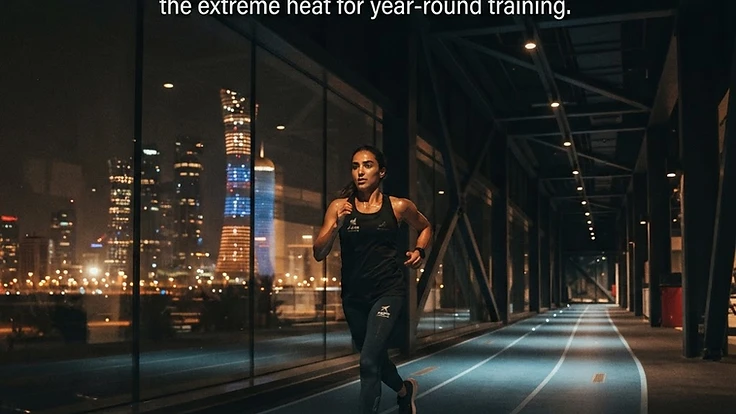
Running on an air-conditioned track is a distinct sensation. As you enter the running corridor at Umm Al Seneem or Al Gharrafa, you can physically feel the thermal drop within two strides. Your legs and torso stay remarkably comfortable, and breathing is significantly easier than on the Corniche.
However, it is not a windowless, hermetically sealed gym. Here is the operational reality:
- Crosswinds dilute the chill: On blustery afternoons, hot desert winds will shear off the upper layer of chilled air. Your lower body might feel 26°C, but your head will register the hotter outside air.
- Traffic congestion: Because these parks cater to everyone, you will share the track with families, strollers, and casual walkers. If you are doing sub-4:00/km tempo intervals, expect to weave continuously around foot traffic during the peak window of 6:30 PM to 9:30 PM.
- Operating schedules: The district chillers do not run 24 hours a day. They generally kick on around 3:00 PM and shut down close to 11:00 PM. Arriving at 6:00 AM for an early morning summer run means you are running on an uncooled path.
Balancing the Track with High-Performance Strength Work
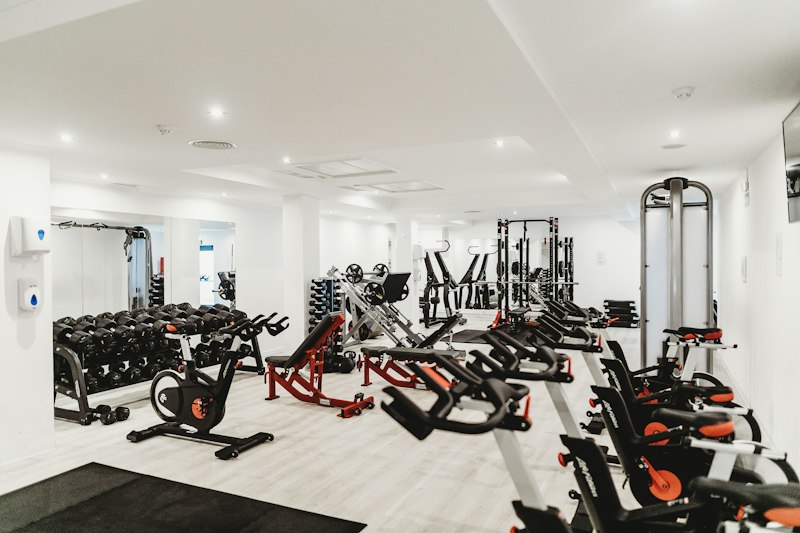
A cooled 1.1km loop at Umm Al Seneem is a game-changer for maintaining baseline aerobic volume without dreading the treadmill. But maintaining an all-round regime in Doha's climate demands structured cross-training. Running in a 26°C microclimate handles your base mileage, but you will still want air-conditioned indoor facilities for high-intensity hybrid conditioning, heavy strength work, and recovery.
If you are near the Aspire Zone or Al Waab, pair your weekly outdoor mileage with structured interval work. Check out View F45 Training Sports City on Fitseeka → for high-output conditioning that keeps your cardiovascular threshold intact when you need pure intensity away from the summer heat.
For runners focused on joint mobility, injury prevention, and core stability, dedicated functional strength and reformer sessions are essential. Consider View Pulso Fitness on Fitseeka → to incorporate Hyrox-style training and structured strength and conditioning that directly benefits your stride efficiency.
Female athletes based out of Al Rayyan or central Doha looking for private training spaces, lane swimming, and mobility work can combine outdoor park sessions with the comprehensive indoor classes at View Aspire Active Ladies on Fitseeka →.
When deep summer fatigue sets in, temperature-controlled contrast hydrotherapy and structured mobility become non-negotiable. Booking recovery time or dedicated studio training in central Doha via the View Mandarin Oriental Fitness Center on Fitseeka → gives your nervous system a break from the relentless ambient weather.
How to Optimise Your Cooled Track Session
To get the most out of Qatar's cooled running corridors, follow a few practical guidelines:
- Time your runs wisely: Aim for either 4:00 PM (just after the chillers have brought the surface down to temperature, before the evening rush) or post-9:30 PM when the family crowd thins out.
- Wear technical moisture-wicking gear: Because the track perimeter is flanked by dense vegetation to preserve the microclimate, humidity within the track trough can remain elevated. Breathable, technical fabric is essential.
- Respect lane rules: Keep clear of the painted cycling lanes. Bicycles, scooters, and rollerblades are restricted from the cooled pedestrian rubber tracks to preserve the surface and avoid collisions.
- Hydrate as if you were in the sun: Do not let the cooler microclimate mislead you into cutting water intake. Doha's ambient atmospheric pressure and sweat rates remain high even when you feel cooler at track level.
The Bottom Line
Qatar's air-conditioned running paths are not a gimmick; they are an ingenious, practical solution to six months of hostile weather. While they cannot fully replace an indoor strength facility or an empty winter road run, loops like Umm Al Seneem and Al Gharrafa keep your legs moving under the open sky when the rest of the city is trapped indoors. Work them into your routine, plan around peak family hours, and leave the treadmill for another day.