The Sand Tax: Why Beach Workouts Hit Differently
Running on tarmac gives you a predictable kinetic return. You push down, the ground pushes back, and you move forward. Dry sand does the exact opposite: it collapses under your forefoot, absorbing your mechanical energy and forcing your stabilizer muscles, calves, and plantar fascia to work almost twice as hard. Sports science data consistently demonstrates that running on loose sand spikes oxygen consumption and heart rate well above equivalent paces on firm ground, all while dampening the joint-jarring impact forces associated with road running.
In Qatar, where coastal shorelines surround us, swapping air-conditioned functional training spaces for the shoreline is an underutilized training stimulus. However, beach fitness in Doha requires more tactical planning than throwing on running shoes and heading into the dunes. Sand consistency varies wildly from the compacted tidal flats of Fuwairit to the fine powder of Sealine, and Qatar’s unforgiving sun leaves zero margin for careless scheduling.
The Best Coastal Locations for Sand Training
Not every stretch of coastline in Qatar works for high-output conditioning. Depending on whether you need packed wet sand for agility drills or deep, unstable dunes for brutal sprint intervals, these are the standout proving grounds:
- Katara Beach: The most accessible shoreline inside central Doha. Because it sits within Katara Cultural Village, it is well-maintained and provides a sheltered bay with minimal tidal drama. The dry sand near the top tier is dense, while the waterline offers a steady surface for shuttle runs. Keep in mind that standard admission fees apply and local dress codes must be respected.
- Fuwairit Beach: Located roughly an hour and fifteen minutes north of West Bay, Fuwairit is famous for kitesurfing, but low tide exposes vast, firm tidal plains. This packed sand allows for near-track running speeds with a low joint impact profile, making it the premier location in the country for tempo runs, long intervals, and open-water swim-run combinations.
- Sealine Beach & Mesaieed: If your objective is pure anaerobic torture, head south past Al Wakrah. The transition zone where the coastal flat meets the foot of the desert dunes offers deep, loose sand. Sand dune ascents at Sealine challenge your glutes, calves, and mental stamina like nothing else, though descending requires absolute ankle stability.
- Simaisma & Al Wakra Beaches: Both municipal coastal areas offer long stretches of open sand during winter mornings. Low tides create wide, flat surfaces suitable for carrying weighted sandbags or running kettlebell circuits away from crowds.
How to Structure a Sand Training Session
Sand amplifies friction and instability, meaning volume must drop while recovery windows expand. If you attempt your standard 45-minute gym HIIT session in loose sand at Sealine, your calves will seize within fifteen minutes. Structure your session around natural movement patterns, plyometrics, and explosive power bursts rather than endless plodding.
A field-tested outdoor template looks like this:
- Preparation: 8–10 minutes of dynamic mobility on the wet sand. Ankle circles, walking lunges, inchworms, and lateral shuffles. Do not skip warm-up sets for your Achilles tendons.
- Power & Agility (Dry Sand): Broad jumps into the sand (soft landing, zero joint shock), followed by 10-yard lateral bounds. 4 sets of 5 reps with complete rest between sets.
- Short-Shuttle Intervals: 20-meter shuttle sprints (5m, 10m, 15m, 20m out and back). Run these near the waterline where the surface gives enough traction to accelerate without slipping backward. Rest 60 seconds; repeat for 5 rounds.
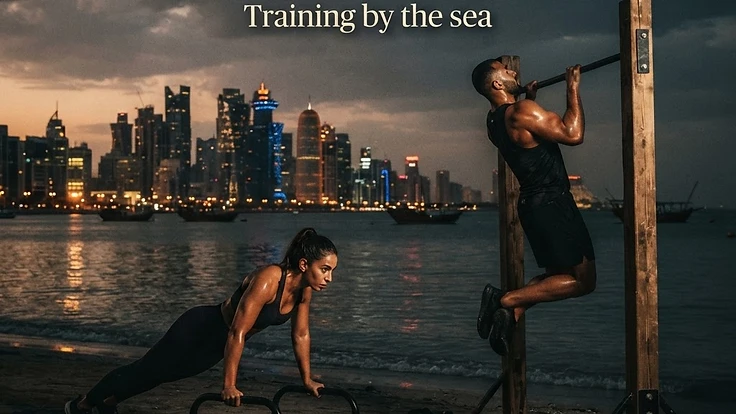
- Bodyweight Finisher: 4 rounds of 15 sand squats, 10 push-ups, and a 50-meter bear crawl across soft sand.
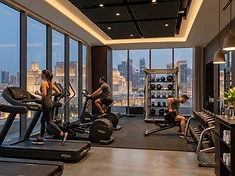
If you prefer an indoor environment to build baseline strength before tackling the beach, consider a visit to View W Doha FIT Gym on Fitseeka → to build up your lower-body endurance and core stability.
Barefoot vs. Footwear: Navigating Qatar's Shorelines
Tempting as it is to kick off your trainers and channel a barefoot fitness lifestyle, Qatar’s coastlines demand discretion. Loose coastal sand frequently hides sharp shell fragments, dry coral shards, and scorching top layers once the sun gets above the horizon.
For deep dune climbs at Sealine, lightweight trail running shoes or tight-weave training sneakers keep fine silica from chewing through your skin. If you train barefoot, reserve it exclusively for clean, monitored resort shorelines or smooth, washed-out tidal lines like Fuwairit during early morning hours. Training barefoot does wonders for strengthening the intrinsic muscles of your feet, but an infection from a hidden piece of marine debris will sideline your season completely.
The Private Shoreline Alternative: Resort Fitness Hubs
If you want the benefits of beach workouts without driving an hour out of town or dealing with public beach restrictions, Doha’s coastal hotels provide private, manicured sand alongside five-star gym amenities. These venues allow you to run sand drills, hit an open-water swim, and immediately transition into a fully equipped strength floor.
For structured coastal strength work in West Bay Lagoon, look into the View InterContinental Doha Beach & Spa Fitness Centre on Fitseeka →, which commands one of the longest continuous private resort beaches in the city. Just down the road, View Grand Hyatt Doha Fitness Centre on Fitseeka → gives athletes a calm private shoreline backed by high-spec strength equipment and dedicated pool lanes.
For residents based on the west side of town around Education City or Msheireb who want a comprehensive indoor strength routine away from the coast, View The Torch Doha Fitness Centre on Fitseeka → in Aspire Zone provides high-performance conditioning facilities designed for serious athletes.
The Rules of Engagement: Climate, Hydration, and Etiquette
Beach training in Doha is seasonal. From late October through mid-April, outdoor conditions are world-class. From May through September, outdoor sand training shifts strictly to 5:00 AM before the radiant heat makes the sand untouchable. Once radiant beach heat exceeds 35°C, high-intensity sand training poses an acute risk of heat exhaustion and severe plantar burns.
Hydration needs out on the beach are double what you require inside an air-conditioned studio. Humidity along the Arabian Gulf traps body heat, suppressing your sweat's evaporative cooling effect. Bring electrolytes, not just plain water, and plan workouts around sunrise.
Finally, keep local public modesty expectations in mind. At public beaches like Al Wakra or Katara, proper athletic attire—standard tees and lined training shorts—is required. Keep speedos and minimal beachwear strictly to private beach clubs and enclosed resort properties.
Make the Coastline Work for You
Training on Qatar's beaches strips away the distractions of digital displays, pin-loaded machines, and crowded lifting platforms. It demands total core stability, punishes inefficient running mechanics, and builds functional stamina that directly transfers back into the gym. Pick your location, time the tide, lace up before the sun cooks the sand, and put the terrain to work.