For decades, living an active lifestyle in the Gulf meant negotiating a hostile climate from behind the wheel of a tinted SUV. You drove to a gym, worked out in recycled air conditioning, and drove home. If you tried to hit 10,000 steps outdoors between May and October, you paid for it within five minutes.
That dynamic is shifting. Driven by the ambitious urban guidelines in the Qatar National Development Framework, municipal planners and master developers are tackling the Gulf's built-in sedentary bias. Doha is quietly deploying microclimate engineering, transit-oriented development, and shaded public spaces to make everyday movement viable year-round. This is not surface-level urban beautification—it is functional infrastructure designed to get people off their couches and onto their feet.
The Microclimate Fix: Outdoor Cooling and Smart Shading
The biggest barrier to outdoor movement in Qatar has always been ambient heat and relentless sun. You cannot willpower your way through a 45°C August afternoon with high humidity. Instead of surrendering to six months of indoor hibernation, Doha began engineering microclimates.
Parks like Al Gharrafa and Umm Al Seneem broke ground by installing outdoor air-conditioned running loops. Utilizing ground-level cooling vents paired with vegetative shading barriers, these tracks pull down track-level temperatures by up to 10°C compared to open asphalt. Similarly, Oxygen Park in Education City uses subterranean topography, sunken pathways, and cantilevered structures to trap cooler evening air and channel the prevailing breeze, making sprint repeats and tempo runs survivable even during shoulder seasons.
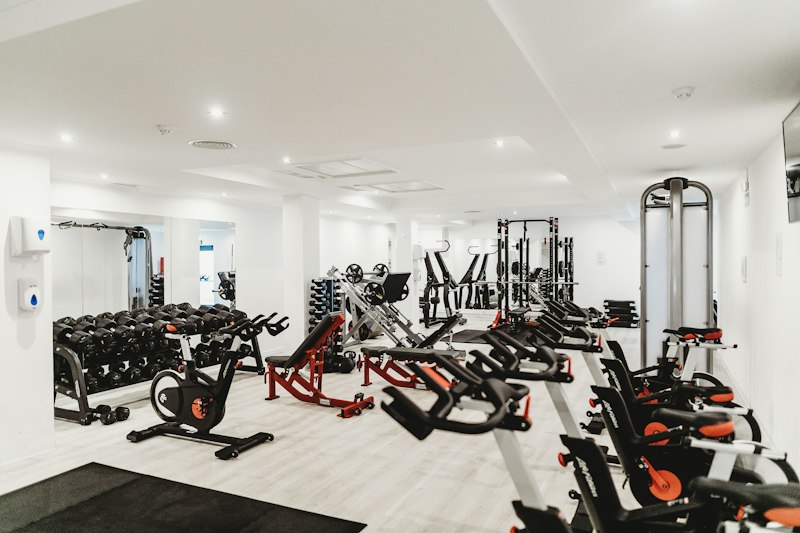
This infrastructural shift does not replace dedicated conditioning work, but it keeps the habit loop alive. Pair an early-morning outdoor run in Oxygen Park with targeted strength sessions at View Pulso Fitness on Fitseeka →, and your routine no longer flatlines when summer arrives.
Msheireb Downtown: The Walkable Urban Core
True walkability is not about building an isolated park; it is about making incidental movement a frictionless part of daily life. For years, Doha's car-centric layout actively discouraged walking. Broad highways and disconnected ring roads meant even a 400-metre errand required a car trip.
Msheireb Downtown Doha took the opposite approach. Built from scratch on traditional Qatari architectural principles, the district aligns narrow pedestrian alleyways (sikkak) to capture prevailing onshore breezes while high-density building masses cast continuous deep shadows across the sidewalks. Retractable awnings, colonnaded walkways, and reflective light-rail tram routes make the district completely navigable on foot.
Walking to a meeting, lunch, or a recovery workout becomes instinctive rather than an ordeal. The district proves that urban density, when paired with climate-responsive design, naturally drives up baseline activity. For residents and professionals in the core, ending a workday with a swim or a movement session at the View Mandarin Oriental Fitness Center on Fitseeka → fits directly into an uninterrupted pedestrian route.
The Corniche to Lusail: Active Transport Arteries
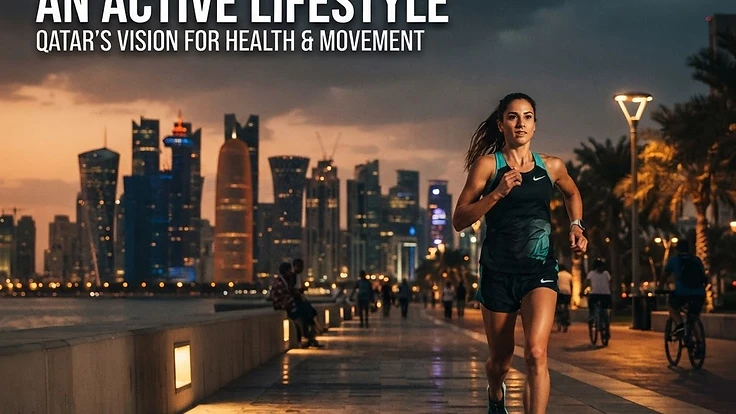
Linear recreation has evolved into connected transit. The 7-kilometre Doha Corniche promenade remains the historic spine of city fitness—unbroken, flat, and ideal for steady-state running and cycling alongside the bay. However, recent infrastructure upgrades have linked central Doha to outward corridors through dedicated pedestrian and bike paths.
Cycle tracks along the Olympic Cycling Track—spanning over 33 kilometres from Doha toward Al Daayen—hold the Guinness World Record for the longest continuous bike path. Lusail Marina Promenade extends that waterfront access north, offering dedicated lanes separated from vehicle traffic.
Active transit is also systematically integrated into the Doha Metro network. Red, Green, and Gold lines feature station plazas designed with wide pedestrian approaches, allowing commuters to substitute half their vehicular commute with walking or scootering. Commuting to a high-intensity session at View F45 Training Sports City on Fitseeka → via the metro eliminates the gridlock of Al Waab Street entirely, turning travel time into functional step counts.
Aspire Zone: The Dedicated Sports City Model
Where Msheireb targets incidental daily steps, Aspire Zone in Al Rayyan remains the gold standard for purpose-built athletic hubs. Originally conceived to train elite athletes, Aspire's 250-hectare footprint acts as the athletic engine of the metropolitan area.
The perimeter features rubberised, shock-absorbent running tracks set among mature parkland, equipped with fitness stations and open turf. Crucially, Aspire’s design ensures dedicated access across all demographics. Alongside community running trails, specialised training hubs like View Aspire Active Ladies on Fitseeka → provide targeted indoor group classes, aquatic fitness, and strength facilities within steps of the main park loops.
By clustering indoor arenas, outdoor tracks, shaded green space, and public transport within a single zone, Aspire removes the spatial friction that kills workout consistency.
What Still Needs Work
Doha's urban fitness transformation is impressive, but it is not finished. Outside master-planned enclaves like Msheireb, Education City, and The Pearl-Qatar, many suburban neighborhoods—such as parts of Ain Khalid, Al Thumama, and Duhail—remain dominated by car traffic, missing sidewalks, and unshaded curb cuts.
Bridging the "last mile" between metro stations and residential villas remains the primary hurdle for universal active transport. For urban fitness to become the default standard across Qatar, the high-density microclimate engineering seen in central developments must trickle down to ordinary neighborhood streetscapes.
The Takeaway
Engineering an active city out of the desert requires more than goodwill and posters promoting healthy living. It takes cooled tracks, continuous shade, protected bike paths, and connected transit hubs. Doha is proving that climate does not have to dictate a sedentary fate—if you build the infrastructure to counter it, people will lace up and move.