
The Blueprint: What Global Systems Got Right
For decades, elite youth football had two undisputed benchmarks: France’s INF Clairefontaine and Barcelona’s La Masia. Clairefontaine mastered raw physical profiling, positional mechanics, and mental fortitude under pressure, cultivating legends like Thierry Henry and Kylian Mbappé. La Masia chose obsessive technical purity, positional play (juego de posición), and cognitive reaction speeds in tight spaces.
Both blueprints proved that world-class footballers are not accidents. They are manufactured through deliberate curriculum, relentless repetition, and brutal scouting filters. But both systems operated in nations teeming with millions of registered youth footballers. When Qatar set out in 2004 to build its own football ecosystem ahead of the 2022 FIFA World Cup, it faced a demographic reality that Clairefontaine and La Masia never had to navigate: a national citizen pool numbering barely over 300,000.
The Aspire Experiment: Adapting the Model in Al Rayyan
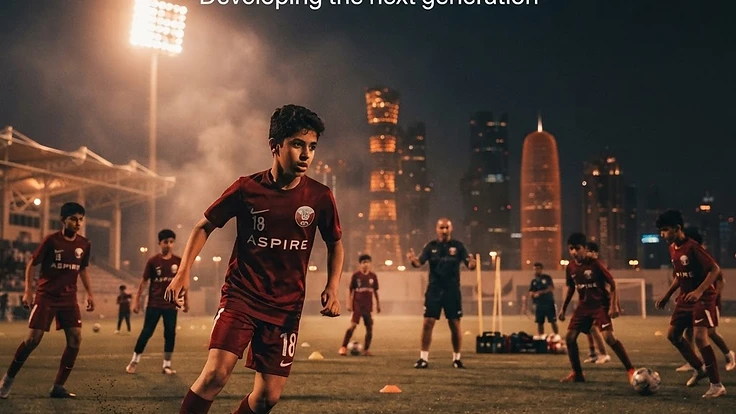
Qatar could not rely on raw numbers. Instead, it built the most heavily resourced talent incubator on earth: Aspire Academy in Al Rayyan. Rising out of the Aspire Zone, the facility operates with European technical directors, cutting-edge biometric monitoring, and proprietary infrastructure like the Footbonaut and indoor full-sized climate-controlled pitches.
Rather than waiting for talent to emerge organically, Aspire decentralised early scouting into Football Talent Centers across Qatar from ages 5 to 8, moving the sharpest prospects into feeder teams by age 9. By the time players reached the full-time boarding curriculum at 12, their lives were split between sports science, secondary education, and double sessions on the pitch.
Critics dismissed the grand experiment for years. Then came the 2019 AFC Asian Cup. Qatar lifted the continental trophy, powered by Aspire graduates Akram Afif and tournament record-scorer Almoez Ali. They defended that continental crown on home soil in early 2024. Roughly 70% of the national senior squad came directly through the Aspire system. The blueprint worked, proving that hyper-dense scientific development can overcome a limited demographic pool.
The Private Grassroots Boom Across Doha
While Aspire represents the state-funded pinnacle for elite Qatari nationals and scouted feeder prospects, the post-World Cup era has supercharged the private academy market. Expats and local youth living from Lusail to Al Wakrah now have access to UEFA- and AFC-licensed setups, international club franchises, and competitive youth leagues operating every weekend.
Parents across Doha are no longer settling for casual kickabouts on battered community pitches. Today, serious programs run across major hubs:
- Education City & Al Rayyan: High-density training hubs leveraging university pitches and community multisport complexes, ideal for families situated in western Doha.
- The Pearl & Lusail: Private commercial academies running out of international school grounds, indoor sports halls, and coastal pitches catering to the northern residential corridor.
- West Bay & Central Doha: Structured skills academies operating out of private club grounds, focusing on small-sided games and technical mastery.
The standard across these private setups has spiked dramatically. European academies like Paris Saint-Germain Academy, Juventus Academy, and local independent coaching organisations compete for youth players, bringing licensed tactical training to regular after-school schedules.
The Doha Factor: Heat, Periodisation, and Physical Prep
Developing football players in the Arabian Gulf introduces challenges that European academies never encounter: oppressive summer humidity and extreme heat. From May through September, outdoor training collapses. Elite youth development in Doha requires intelligent climate periodisation.
During the brutal summer months, serious academies shift indoors, moving to climate-controlled multisport halls or pivoting toward futsal to keep touches sharp without risking heat exhaustion. Conditioning shifts toward targeted indoor strength, agility, and mobility.
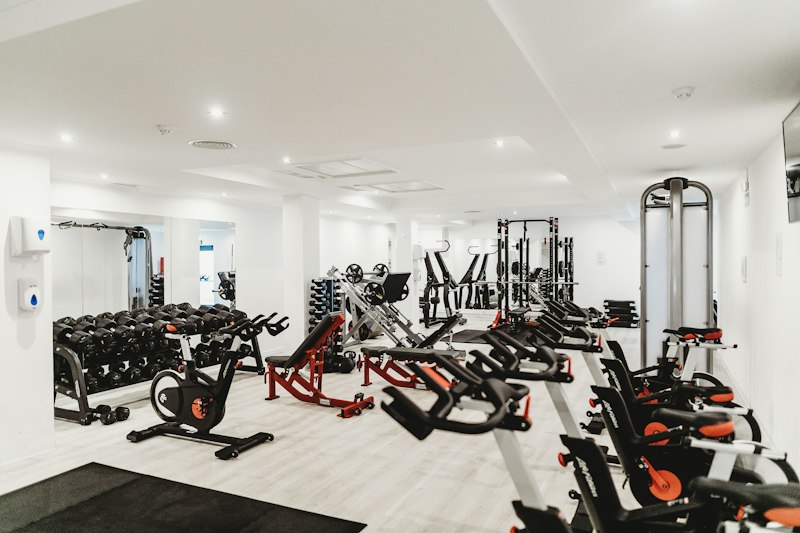
For older youth athletes and competitive amateurs balancing heavy training regimes, cross-training and strength work outside the academy pitch are non-negotiable. Modern football demands bulletproof hamstrings, core stability, and high aerobic thresholds. Parents in Al Rayyan frequently pair youth development routines with nearby family conditioning hubs; facilities like View Aspire Active Ladies on Fitseeka → provide dedicated athletic programming right next door to the Aspire pitches.
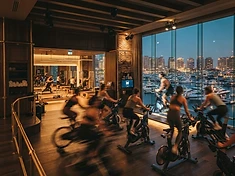
For youth looking to bridge the physical gap between technical drills and match-day power, functional conditioning centers provide the raw athletic base. Programs at spots like View F45 Training Sports City on Fitseeka → deliver the high-intensity anaerobic conditioning essential for 90-minute pitch endurance.
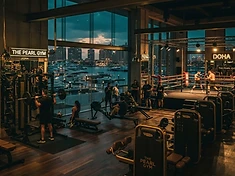
Similarly, adult players and academy seniors training in the central city frequently use dedicated athletic spaces such as View Pulso Fitness on Fitseeka → to build the core stability, Hyrox-style stamina, and joint resilience required to survive physical tackles and prevent non-contact knee injuries.
Recovery, Biomechanics, and Youth Burnout
Doha's football ecosystem has access to some of the world's finest sports science, anchored by Aspetar's presence in Sports City. But at the private grassroots level, overtraining remains a constant threat. Young players often balance school squads, commercial academies, and casual evening games, putting developing joints under chronic strain.
Modern European academies prioritise proactive recovery just as much as ball work. Elite recovery routines require more than sitting on the couch after a Friday match:
- Hydrotherapy and Swimming: Non-impact pool sessions flush lactic buildup while unloading mechanical stress from young knees and ankles. Access to quality lap facilities, such as the View Mandarin Oriental Fitness Center on Fitseeka → in Msheireb Downtown, offers elite recovery options right in the city core.
- Progressive Load Management: Tracking session frequency so young bodies do not play seven days a week through growth spurts.
- Mobility and Soft-Tissue Work: Regular dedicated mobility drills to counter tight hip flexors and calves caused by synthetic turf surfaces.
What to Look for in a Doha Academy
Not every academy charging premium monthly fees delivers real coaching. Flashy kit drops and social media highlight reels do not make a footballer. If you are investing in a child’s development in Qatar, inspect what actually happens between the white lines:
- Coach Credentials: Demand coaches holding genuine UEFA, AFC, or FIFA B/A licenses. A recognizable club crest on the coach’s tracksuit means nothing if the person running the session lacks youth pedagogy credentials.
- Ball Rolling Time: Watch a session. If kids stand in line for three minutes to take one shot on goal, walk away. Quality academies structure small-sided possession boxes where players touch the ball dozens of times every five minutes.
- Player-to-Coach Ratios: Caps should strictly sit between 1:10 and 1:12. Anything larger becomes crowd control, not player development.
- Surfaces and Safety: Inspect the turf quality. Compressed, worn-out 3G turf causes repetitive joint stress and ankle rolls. Look for well-maintained shock-pad underlays and covered, shaded, or indoor venues during transition seasons.
The Long Game
Building a footballer requires years of disciplined, quiet work. Qatar proved at the highest international level that world-class talent can be forged through meticulous infrastructure, elite coaching, and strategic intent. Whether your child is aiming for the national team feeder system or simply learning how to dominate a game with their weak foot, Doha now has the framework to make it happen. Choose substance over branding, prioritize physical longevity, and demand real coaching.