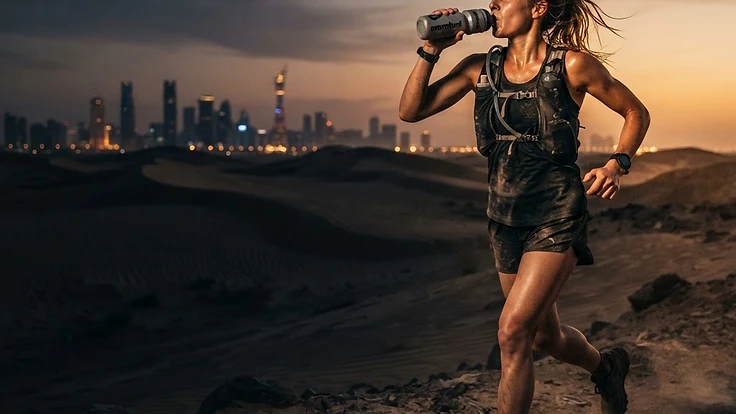
The Qatar Reality: Why Standard Advice Fails
The standard global rule of two litres of water a day is useless in Qatar. That benchmark was established for temperate climates where a brief walk outdoors does not instantly trigger heavy perspiration. In Doha, ambient temperatures routinely exceed 45°C during the peak months, while coastal humidity blowing across West Bay, Lusail, and The Pearl drives the apparent heat index far higher.
When humidity is high, sweat cannot evaporate efficiently from your skin. Evaporation is your body’s primary mechanism for cooling off; when it stalls, your core body temperature rises rapidly, forcing your sweat glands to work harder. You lose fluid at an accelerated rate, even during mundane activities like walking through an outdoor parking lot in Al Sadd or pacing between meetings in Msheireb Downtown. By the time your brain registers thirst, you are already operating at a 1% to 2% body water deficit, which measurably degrades strength, aerobic endurance, and cognitive focus.
Setting Your Baseline: How Much Water Daily?
In Doha's climate, a healthy, sedentary adult spending most of their time in air-conditioned interiors needs a baseline of roughly 2.5 to 3.5 litres of fluid daily. If you train indoors at an air-conditioned studio or gym, that baseline rises to 3.5 to 4.5 litres. For endurance athletes running along the Doha Corniche at dawn or doing intense conditioning outdoors, requirements can climb well past 5 to 6 litres across a 24-hour cycle.
However, hydration is not about drowning yourself in water all at once. The human kidneys can only process around 800 to 1,000 ml of water per hour under normal conditions. Chugging a two-litre bottle after a workout does little beyond triggering frequent urination and diluting your blood serum sodium. The practical rule is steady intake: drink between 200 ml and 300 ml every 20 to 30 minutes throughout the day.
The Indoor Trap: Air Conditioning and Passive Dehydration
Most residents in Qatar spend up to 90% of their day indoors under heavy HVAC refrigeration. Central air conditioning strips ambient moisture out of the air. Spending eight hours in a chilled office tower in West Bay or browsing at Place Vendôme in Lusail accelerates respiratory and transdermal water loss—you exhale moisture continuously without realizing it.
Because you are cold, your thirst mechanism becomes blunt. You step outside into the searing humidity of the mid-afternoon, and your system suddenly faces intense thermal stress while already subtly hypohydrated. Keep a dedicated, measurable flask at your desk and sip consistently, regardless of whether you feel thirsty.
The Sweat Math: Plain Water vs. Electrolytes
Sweat is not just water; it is a blend of minerals, primarily sodium and chloride, with smaller amounts of potassium, magnesium, and calcium. If you train hard and replace heavy sweat losses exclusively with plain water, you risk hyponatremia—a condition where sodium concentrations in your blood drop dangerously low, causing nausea, headaches, confusion, and muscle cramping.
Assess your need for electrolytes based on intensity, duration, and environment:
- Indoor sessions under 60 minutes: If you are doing a 45-minute strength or low-intensity mobility session in a climate-controlled room, clean water combined with your normal dietary salt intake is plenty.
- Intense conditioning and Hyrox: For demanding indoor metabolic work, functional training, and high-intensity circuits—such as the programming at View Pulso Fitness on Fitseeka →—adding a targeted electrolyte packet containing 500–800 mg of sodium per litre helps sustain power output and prevents late-session drops in blood pressure.
- High-volume strength and CrossFit: Hard barbell efforts and heavy conditioning at facilities like View Strongbox Qatar on Fitseeka → will drain glycogen and pull mineral stores with it. An intra-workout beverage with both sodium and light carbohydrates improves absorption through the gut via the sodium-glucose cotransport mechanism.
- Boutique fitness, reformer, and boxing: For high-paced group classes or sparring sessions at View The Venue Ladies on Fitseeka →, hydrating before you enter the studio is critical. Arrive with pale straw-coloured urine, and sip an electrolyte-infused mix if the workout exceeds 50 minutes of sustained elevated heart rate.
- Outdoor training: If you run loops around Aspire Park or cycle the Olympic Cycling Track, electrolytes are non-negotiable. Aim for 700 to 1,000 mg of sodium per litre of fluid consumed during outdoor summer efforts.
Timing Your Intake Around High-Intensity Workouts
Hydration is a rolling 24-hour commitment, not something you scramble to fix 10 minutes before warm-up. Drinking half a litre of water immediately before an intense class like the intervals at View F45 Training Sports City on Fitseeka → will only leave water sloshing uncomfortably in your stomach.
Structure your fluid timeline predictably:
- Two to three hours before training: Drink 500 ml of water or a weak electrolyte solution. This allows your kidneys time to balance fluid levels and excrete any excess before you begin.
- 15 to 20 minutes before training: Take 150 to 250 ml of water to prime circulation without bloating the stomach.
- During the workout: Sip 100 to 200 ml every 15 minutes. Avoid large gulps. Match your intake to your sweat rate; you should finish the session feeling challenged, not waterlogged.
- Post-workout recovery: Weigh yourself before and after extreme sessions if you want absolute precision. For every kilogram of body mass lost through sweat, drink 1.2 to 1.5 litres of fluid over the following two to four hours, accompanied by a balanced meal containing sodium and potassium.
How to Check Your Real-Time Hydration Level
Ignore fancy bioimpedance scales for fluid measurement; they fluctuate wildly depending on skin temperature and recent meals. Rely on two reliable field metrics instead:
1. Urine colour: Check your first and second urination of the day. A pale straw or light lemonade colour indicates adequate hydration. Dark apple juice or iced-tea shades indicate moderate to severe hypohydration that must be corrected immediately. If your urine is completely clear like tap water all day, you are over-consuming fluid and stripping out essential minerals.
2. Morning body weight stability: If you step on the scale upon waking and find you are down 1 to 1.5 kilograms compared to the previous morning—without any intentional caloric deficit—you are looking at water debt accumulated from yesterday's heat exposure.
The Verdict
In Qatar, hydration is not an afterthought or a wellness trend; it is basic physiological maintenance. Quit guessing your intake and stop relying on late thirst cues. Hit a baseline of 3 to 4 litres daily, respect the hidden drying effects of office air conditioning, and deploy sodium strategically whenever your training intensity rises. Dial this in, and your recovery, energy, and workout performance will instantly shift.