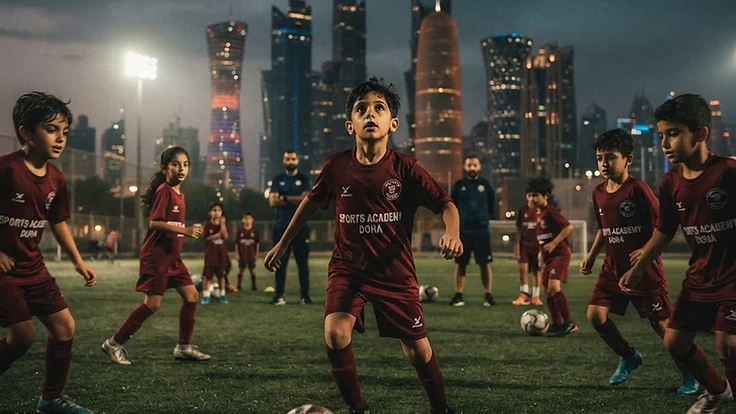
Signing up a child for a sports academy in Doha often feels like a gamble. Flashy flyers promise European scouting networks, Olympic conditioning, and elite coaching. In reality, half of them are glorified babysitting sessions where twenty kids stand around a single cone while an unvetted instructor scrolls through their phone. You pay premium Gulf rates—often between QAR 600 and QAR 1,200 a term—for very little athletic output.
Yet Doha holds some of the best sports infrastructure on earth. Between the sprawling turf of Aspire Zone, the Olympic pools in Education City, and private community clubs dotting Lusail, West Bay, and The Pearl, the facilities are world-class. If you want your child to develop fundamental movement skills, tactical discipline, and real physical resilience, you just have to know how the local youth sports ecosystem actually works.
The Long-Term Athlete Development (LTAD) Problem in Doha
Globally, top youth development models rely on Long-Term Athlete Development (LTAD). That framework stresses multi-sport engagement, foundational agility, balance, and coordination before age twelve, followed by sport-specific specialization. In Doha, the market pushes hard in the opposite direction. Parents demand early specialization—usually football, padel, or swimming—by age six, hoping for instant mastery.
When six-year-olds do repetitive drills five days a week without learning general motor literacy, two things happen: overuse injuries and early burnout. Many young athletes who enter intense academy setups in Doha abandon sport entirely by age fourteen. Look for programmes that emphasize multi-sport cross-training and agility before they force your child into rigid positional play.
Football Academies: Distinguishing Real Coaching from Babysitting
Football dominates youth sport in Qatar. From pitches in Al Sadd and Al Waab to dedicated clubs around Al Rayyan and Al Wakrah, options are endless. European club franchises (such as Paris Saint-Germain Academy and Juventus Academy) operate heavily across private international school venues in West Bay, Madinat Khalifa, and Al Messila. Elite Sports Academy runs full structured leagues on the pitches at Aspire Zone.
When evaluating a football academy, look past the branded kit:
- Coach-to-child ratio: It should never exceed 1:10 for kids under ten, and 1:12 for older youth. Anything higher turns into crowd control.
- Curriculum progression: Ask to see the seasonal syllabus. If sessions aren't grouped into clear technical themes (dribbling in tight spaces, bilateral control, scanning before receiving), the coaches are just winging it.
- Competitive play: Reputable academies participate in formal leagues or play structured weekend fixtures rather than only holding practice sessions. Internal matchplay is where game intelligence actually develops.
Aquatics and Swimming: Getting Beyond Basic Water Safety
Living on a peninsula where summer daytime temperatures top 45°C means indoor pools are non-negotiable. Doha has no shortage of swim schools, operating out of compounds in The Pearl, hotels, and purpose-built venues like the Hamad Aquatic Center.
Most swim schools do a decent job getting children water-safe (floating, basic crawl, survival skills). But if your goal is competitive aquatics or stroke mechanics, the gap between entry-level lessons and high-performance stroke work is enormous. For older children and parents looking to build supplementary conditioning alongside swimming, private wellness clubs like the View Mandarin Oriental Fitness Center on Fitseeka → offer targeted environments for personal stroke refinement, mobility, and recovery away from noisy public lanes.
Combat Sports: Building Real Mental and Physical Armor
Martial arts academies are experiencing a massive surge across Qatar, especially Brazilian Jiu-Jitsu (BJJ), judo, and kickboxing. While traditional karate and taekwondo hold strong appeal for younger age groups in Msheireb and Al Sadd, BJJ offers something far more functional: live sparring with minimal concussion risk.
In a good grappling academy, children learn leverage, emotional control under stress, and physical grit. When checking out combat academies in Lusail or West Bay, observe a class first:
- Do the instructors command quiet respect, or are kids running wild across the mats?
- Is sparring supervised with strict safety boundaries and clear rules on submissions?
- Are warm-ups treated as genuine mobility and neck/spine stabilization sessions, or just generic jumping jacks?
The Rise of Youth Strength and Conditioning
The old myth that lifting weights stunts a child’s growth has been thoroughly debunked by sports science. Youth resistance training—done with bodyweight, medicine balls, light kettlebells, and resistance bands—strengthens tendons, improves bone mineral density, and radically reduces ACL and ankle injuries on the pitch.
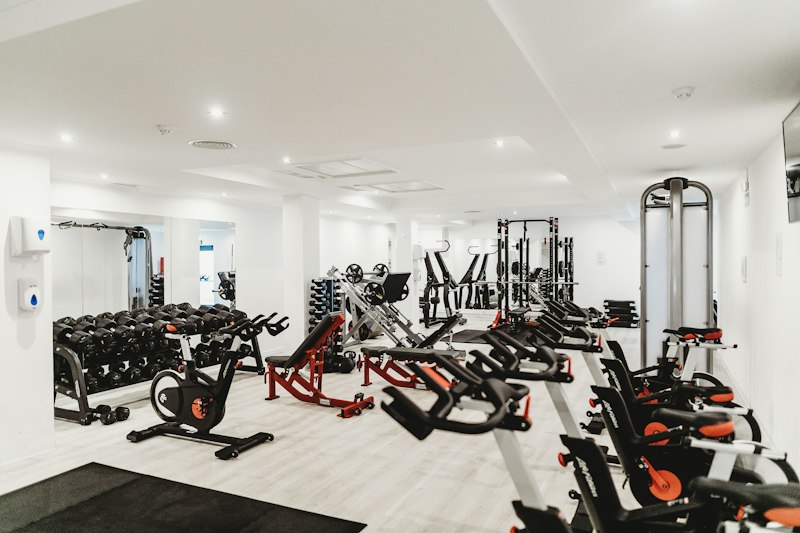
As teen athletes progress, standard school PE classes fail to deliver the strength base required for competitive sport. Dedicated performance facilities like View MY GYM Sports on Fitseeka → provide the heavy lifting, strength work, and athletic conditioning teens need to build durability. Similarly, functional team training setups like View Pulso Fitness on Fitseeka → help older teenagers develop aerobic thresholds, speed mechanics, and cross-discipline fitness before high-stakes fixtures.
Managing the Doha Climate and Seasonality
Qatar's climate creates a unique training calendar. The prime development window runs from October to April, when outdoor pitches in Aspire, Al Gharrafa, and Education City are in constant use. Once mid-May hits, the entire youth sports industry shifts indoors or shutters completely.
Top-tier academies have pre-booked access to air-conditioned sports halls or covered domes, such as the Aspire Dome. If an academy's summer strategy involves keeping kids outdoors on Astroturf pitches at 6:00 PM in July, walk away. Heat exhaustion impairs learning and puts children at immediate medical risk. During peak heat months, parents frequently transition their teens to indoor conditioning hubs like View F45 Training Sports City on Fitseeka → to sustain work capacity without heat stress.
The Bottom Line
Your child does not need a flashy European logo on their jersey to become a competent athlete. They need low coach-to-student ratios, coaches who teach footwork and spatial awareness instead of shouting at referees, and a training environment that builds long-term physical literacy. Demand a trial session, watch how the coaches handle the slowest kid in the group, and invest where the fundamentals are taught right.