From Master Plan to Movement
Most cities treat sports infrastructure as an afterthought. You get a park tucked between two highways, a narrow cycle lane painted onto a congested ring road, and commercial gyms shoehorned into office basements. For years, Doha athletes navigated around that fragmentation—heading to the Corniche for dawn runs, fighting West Bay traffic, or driving southwest out to Aspire Zone whenever they needed serious athletic facilities.
Lusail was engineered with a completely different logic. Conceived from the ground up across 38 square kilometres, the city applied the concept of sports urbanism seen in developments like Manchester’s SportCity and Dubai Sports City, but scaled it into an entire metropolitan fabric. It isn’t just home to an 80,000-seat World Cup final venue; it was mapped out so that active lifestyle infrastructure—wide pedestrian promenades, dedicated cycling circuits, waterfront tracks, and high-spec independent gyms—is woven straight into the residential districts.
The Outdoor Grid: Real Pedestrian and Cycling Infrastructure
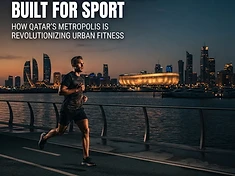
Doha runners and cyclists know the drill: outside of five months of winter, outdoor movement requires smart route selection, lighting, and zero road intersections. Lusail Marina Promenade delivers one of the most uninterrupted waterfront running tracks in Qatar, stretching past the skyline with shock-absorbing surfaces and clear sightlines that rival the classic Corniche route without the heavy traffic fumes.
Beyond the Marina, Lusail’s master plan dedicated roughly 17% of its total land footprint to parks, landscaped green corridors, and open public zones. Connected directly to the Lusail Tram network, the city integrates active mobility with clean transit. That means you can finish an interval session, hop on the light rail, and reach residential towers across Fox Hills or Marina Promenade without relying entirely on a car. During the cooler winter months, the wide avenues around Lusail Boulevard transform into high-footfall running routes that connect smoothly with the broader Olympic cycling track grid heading out toward Al Khor.
The Next-Gen Strength and Conditioning Hubs
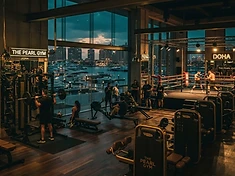
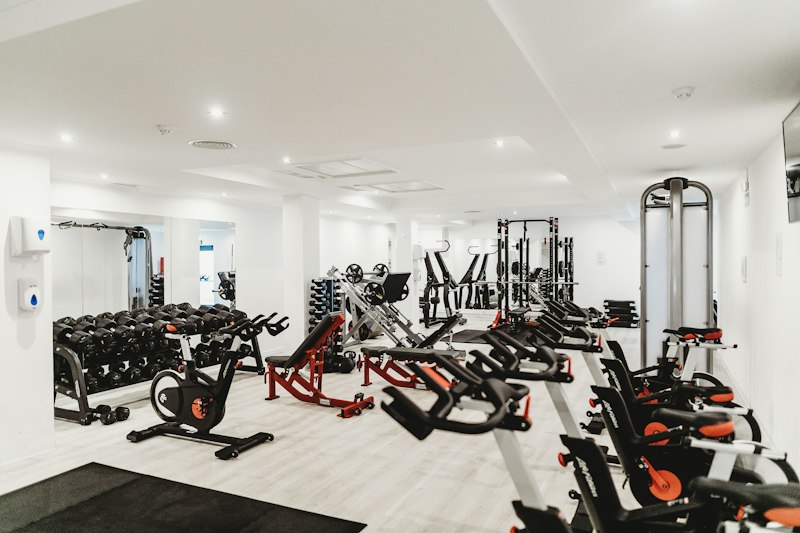
A walkable city layout is useless without top-tier training facilities to back it up. Lusail has rapidly attracted performance-first gyms that skip the generic hotel-gym tropes in favor of specialized strength, combat, and functional fitness setups.
For athletes prioritizing combat sports alongside serious iron work, View Gymmito Fitness Club (Lusail) on Fitseeka →. It anchors the local combat community with purpose-built spaces for boxing and MMA, paired with full strength and conditioning zones and personalized training programs.
If your programming leans toward heavy compound lifts, bodybuilding, or coach-led group lifting, View Adrenaline Gym on Fitseeka →. Rather than catering to casual treadmill walkers, the facility focuses on progressive overload, dedicated free weights, and functional conditioning designed for high-output athletes living in the district.
The Functional Fitness and Hyrox Boom
Lusail has also positioned itself at the center of Qatar's functional fitness movement. While central Doha relies on established cluster zones—such as View F45 Training Sports City on Fitseeka → over by Aspire—Lusail has built out venues specifically tailored for the booming competitive endurance scene.
With Hyrox and high-intensity hybrid events rapidly growing across the Gulf, athletes require large-format training grounds capable of hosting sled pushes, wall balls, rowers, and running intervals all under one roof. That is where View The Zone Gym on Fitseeka → fits in. Built explicitly around Hyrox programming, functional training, and high-demand group conditioning, it gives northern Doha and Lusail residents a dedicated competition-grade training floor.
Padel, Watersports, and Open-Air Training
Sports cities live and die by their community recreational spaces. In Lusail, open-air sport is not isolated to an arena boundary. The boom of padel courts has swept through Qetaifan Islands and the Marina districts, establishing regular after-work leagues for local professionals.
Meanwhile, the coastal layout supports watersports, from open-water paddling in the protected lagoons to kayak sessions when sea conditions are flat. It mirrors the waterside culture of The Pearl-Qatar, but with wider access roads, modern parking facilities, and fewer bottleneck traffic snarls during peak hours.
Where Lusail Works—and What Still Needs Work
Lusail gets a lot right. The scale of the sidewalks, the integration of light rail, and the caliber of independent strength facilities make it one of the most livable, active districts anywhere in the Gulf. You can walk out of your apartment, hit a sub-4:00/km tempo run along the water without stopping at a single traffic light, and walk into an elite gym within five minutes.
The trade-off is the summer climate and ongoing development. Lusail’s sprawling wide boulevards offer minimal natural shade compared to dense urban centers like Msheireb Downtown Doha. Between June and September, open-air training shifts strictly before 6:00 AM or deep into the evening along chilled indoor tracks and air-conditioned functional facilities. Additionally, active construction in outer zones means you still need to plan your running routes around completed districts rather than cutting blindly across the map.
The Verdict
For decades, Aspire Zone set the benchmark for athletic infrastructure in Qatar. But Aspire is primarily a sports destination—somewhere you commute to for a workout. Lusail is different: it is an actual city engineered around the premise that you should live, work, and train on the same grid. If fitness is a core component of your daily routine, Lusail is no longer an up-and-coming promise—it is Doha’s premier training territory.