If you live in Doha, your daily step count usually requires an aggressive act of will. Between six-lane ring roads, disconnected sidewalks, and half the year spent hiding in air-conditioned vehicles, moving on your own two feet is rarely the default choice. Most residents drive to an indoor facility, park in a basement, grind out an hour on a treadmill, and drive back home. That is car-centric survival, not sustainable movement.
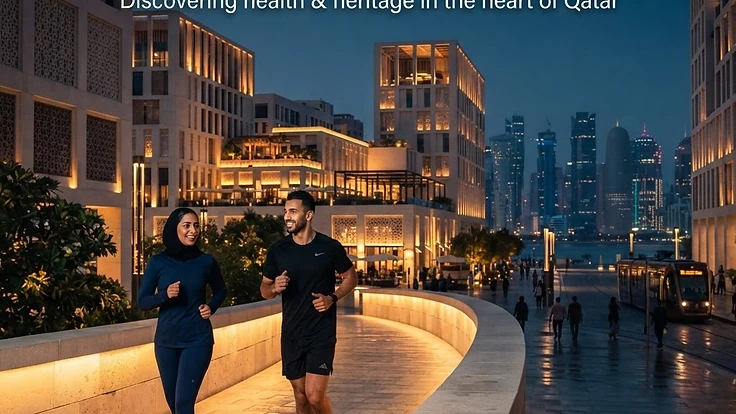
Msheireb Downtown Doha flips that script. Spread across 31 hectares in the historic heart of the city, Msheireb was engineered from the bedrock up to make pedestrian transit functional, comfortable, and intuitive. For anyone looking to weave natural, low-intensity physical activity into their lifestyle without simply circling an air-conditioned mall, Msheireb offers a working blueprint for pedestrian-first fitness in the Gulf.
The Thermal Architecture of Outdoor Movement
The primary barrier to outdoor activity in Qatar is obvious: microclimate heat. In car-heavy districts like West Bay or broad suburban stretches around Al Rayyan, wide asphalt roads store and radiate heat long after sunset. Pedestrians get baked both from above and below.
Msheireb counters this through vernacular Qatari design backed by contemporary engineering. The master plan relies on compact, closely massed mid-rise buildings that cast continuous structural shadows across the street grid. Pedestrian thoroughfares are angled deliberately to channel cooler prevailing breezes off the Arabian Gulf. Combined with deep colonnades, thick overhangs, and light-coloured limestone that deflects solar radiation, the ambient street-level temperature feels significantly cooler than standard open streetscapes.
Along key arteries like Sikkat Al Wadi, embedded water features and evaporative cooling techniques temper the outdoor air. This architectural shade matrix means outdoor walking does not become impossible the moment April arrives. It extends the viable outdoor walking season by weeks on both ends of winter and keeps early morning and post-dusk pedestrian activity realistic.
Integrating Transit with Everyday Movement
A walkable neighborhood is only as functional as its connectivity. At the center of the district lies Msheireb Metro Station, the central interchange where the Red, Green, and Gold lines converge. That makes it one of the rare spots in Qatar where you can commute completely car-free from almost anywhere—from Lusail in the north to Al Wakrah in the south.
Step out of the station, and all logistics disappear beneath the surface. Deliveries, maintenance operations, and more than 10,000 parking spaces are hidden away in subterranean levels. This eliminates curb conflicts, delivery truck obstacles, and idling engines. The street grade belongs entirely to people.
Circulating the district is a 2.1-kilometer free electric tram loop stopping at nine stations. Rather than replacing walking, the tram functions as an active lifestyle tool: you can walk briskly across the district for your steps, grab lunch or coffee, and use the tram to hop back to your starting point without doubling back across midday heat.
Designing a Daily Walking Circuit
Hitting 10,000 steps a day in Doha without a treadmill usually requires driving out to the Aspire Zone park loop, the Lusail Marina promenade, or the Corniche. In Msheireb, you can accumulate those steps simply by navigating the urban fabric.
A practical, repeatable 3-to-4-kilometer loop through Msheireb highlights how modern streetscapes encourage active travel:
- Barahat Msheireb: Begin at the largest open-air covered square in the region. The retractable canopy provides full overhead cover, creating an ideal setting for a brisk warmup circuit before heading down the adjacent alleyways.
- Sikkat Al Wadi: A dedicated pedestrian spine lined with cafés and water features. The street is wide, vehicle-free, and flanked by deep building canopies that block harsh lateral sun.
- Heritage Quarter: Move eastward toward the Msheireb Museums, where restored traditional courtyards offer low-traffic, visually engaging paths.
- Galleria and Al Kahraba Street: Loop back through Al Kahraba Street, modern Doha’s original illuminated shopping road, using the wide, continuous sidewalk network.
Because the streets are physically protected from motor vehicle intrusion, you walk at a steady, rhythmic clip without constantly stopping for curb drops or turning cars.
Balancing Incidental Steps with Structured Training
Incidental movement—the non-exercise activity thermogenesis (NEAT) built into everyday errands—lays the foundation of long-term health. But pairing that base with deliberate strength and conditioning is where body composition and performance take off.
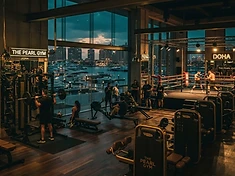
Within Msheireb itself, high-end wellness facilities provide structured performance spaces right along the pedestrian grid. If you need dedicated personal coaching, recovery circuits, or technical movement work, you can walk straight into the Mandarin Oriental Fitness Center right off the main square. There is no driving across town or hunting for parking; your warmup is the walk itself.
For high-intensity functional circuits, dedicated indoor community hubs in surrounding districts balance out your weekly programming. If you train for timed strength, conditioning, and competitive fitness benchmarks, facilities like Pulso Fitness provide the intensive barbell and metabolic work that street walking cannot replicate.
Similarly, when structured team-based conditioning is on the agenda, hopping on the metro or making a short commute connects you directly to hubs like F45 Training Sports City or dedicated women's athletic programs like Aspire Active Ladies. The benefit of living or spending active hours in a walkable core is that your gym commute stops being another forty minutes sitting behind a steering wheel in rush-hour traffic.
The Reality Check: What Works and What Doesn’t
Msheireb is a genuine achievement in urban design, but it is not without limits. Let's look at the practical realities:
- High Summer Midday: From late June through August, no amount of colonnades, evaporative misters, or sea-breeze orientation can fully defeat 45°C ambient heat and crushing humidity. During peak summer, your walking window narrows strictly to pre-7:00 AM or late evenings.
- Scale: At 31 hectares, Msheireb is a contained district. Long-distance endurance runners will find the loop repetitive if they are clocking 15+ kilometers without crossing major highways toward the Corniche or Souq Waqif.
- The Surrounding Perimeter: The moment you cross the exterior perimeter toward Jaidah Flyover or Old Al Rayyan Road, the pedestrian infrastructure ends abruptly. Msheireb is an urban island, though its connection to Souq Waqif via the pedestrian underpass remains a seamless route expansion.
The Takeaway
Msheireb proves that heat is not the sole reason Gulf cities are inactive; poor car-first street planning is just as culpable. By pairing shaded architecture, underground traffic, and integrated rail, Msheireb allows Doha residents to do something rare: step out the front door, get their heart rate up, and move comfortably under the open sky.