The Glass Box Obsession
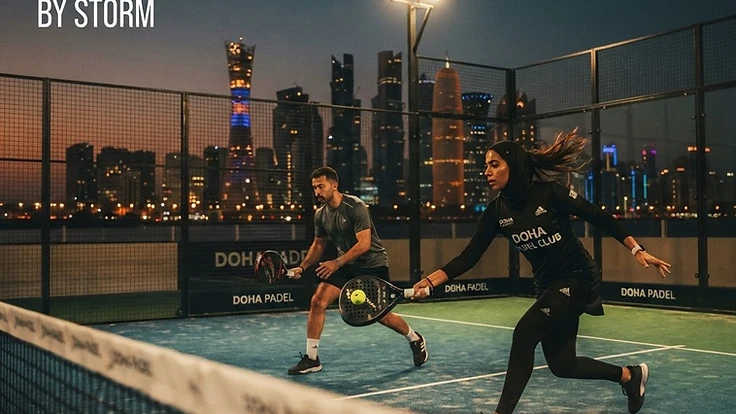
Drive past Khalifa International Tennis and Squash Complex on a Tuesday night at 9:00 PM, and the traditional clay and hard courts are half empty. Turn the corner toward any padel hub across Doha, however, and the parking lots are completely backed up. Over the past five years, padel has gone from an obscure racquet hybrid to the undisputed cultural heavyweight of Qatar's amateur sporting landscape.
The numbers explain part of the story: globally, padel boasts over 25 million active players. Qatar Sports Investments (QSI) acquired the World Padel Tour to form Premier Padel, putting Doha at the absolute center of the professional calendar. But the real frenzy is grassroots. From Msheireb to Lusail, booking a court between 7:00 PM and 11:00 PM on a weekday requires fast fingers on Playtomic or having a venue manager on speed dial. Padel did not just arrive in Qatar; it annexed the evening routine of thousands of locals and expats alike.
Why Padel Dominated the Gulf So Quickly
Padel succeeded in Doha where other sports hit a wall because it directly solves the unique constraints of living in the Gulf.
- The Social Doubles Dynamic: Traditional tennis demands months of lessons just to sustain a four-shot rally, and squash is notoriously solitary and punishing. Padel is played almost exclusively in doubles on a court 25 percent smaller than a tennis court. It is conversational. You play, you chat, and you hit specialty coffee spots in West Bay or Al Sadd immediately afterward.
- The Summer Climate Workaround: Outdoor running along the Corniche or outdoor football becomes physically miserable from May to September. Qatar countered this by building some of the world's finest air-conditioned indoor facilities, allowing high-intensity play year-round.
- A Low Learning Curve: Because the racquets are stringless carbon-fibre bats and the court is enclosed by glass walls that keep balls in play, beginners can sustain exciting rallies during their very first hour on court.
Where to Play: Doha's Core Padel Hubs
Whether you want a casual hit after work or a competitive league setup, Doha's court landscape divides into massive specialized clubs, community locations, and luxury hotels.
1. Padel In (Aspire Zone & City Center Doha)
Padel In pioneered indoor play in the country. Their facility at Aspire Zone is recognized as the largest indoor padel venue in Asia and Africa, housing 13 indoor courts under high ceilings with professional-grade turf. If you need a game in central Doha during peak summer humidity, their City Center location also offers completely climate-controlled indoor courts.
2. Luxury Resort Courts (The Pearl & Lusail)
If you prefer seaside settings, several top hotels feature courts with five-star amenities. Marsa Malaz Kempinski at The Pearl and Waldorf Astoria Lusail both offer immaculate courts with valet parking and seaside breezes. Just be aware that during transitional weather months, outdoor hotel courts fill up quickly with corporate bookings and private groups.
3. Downtown & Boutique Courts
Venues like Doha Oasis in Msheireb and Al Messila Resort cater to inner-city players who want quick access straight from the office before traffic builds up along C-Ring Road. Dedicated ladies-only courts and private sessions are also widely available at venues across Al Sadd and Markhiya.
The Fitness Reality: What Padel Does (and Doesn't) Do
There is a misconception that because padel is easy to pick up, it is a low-effort workout. Play an intense 90-minute match, and your heart rate monitor will show otherwise. Padel demands rapid acceleration, lateral deceleration, rotational core torque, and fast visual tracking. The constant change of direction burns substantial calories and builds exceptional calf and hip endurance.
However, padel has physical limits. It is largely an anaerobic interval sport with asymmetrical load—your dominant shoulder, elbow, and wrist take all the impact. To play four nights a week without picking up lateral epicondylitis (tennis elbow) or knee patellar issues, you must balance match play with unilateral strength work, posterior chain conditioning, and targeted mobility.
If you play regularly in Lusail, dialing in your rotational power and joint resilience at a facility with dedicated strength and conditioning gear is essential. View Gymmito Fitness Club (Lusail) on Fitseeka → to build the hamstrings, glutes, and shoulders needed to handle fast court transitions without breaking down.
Similarly, for players living around the lagoons and towers of Porto Arabia, cross-training with functional lifts and restorative yoga will do far more for your court agility than simply playing another match. View Gymmito Fitness Club (The Pearl) on Fitseeka → to access structured strength coaching just minutes from the courts.
How to Book Courts and Find Matches
You cannot simply show up at a venue in Doha expecting an open court. Court culture here runs almost exclusively through automated apps and active WhatsApp groups.
- Playtomic App: The standard booking platform across Qatar. Most clubs release time slots 3 to 7 days in advance. Evening slots (8:00 PM to 10:00 PM) disappear within minutes of release.
- Level Verification: If you want to join open competitive matches without bringing three friends, Playtomic tracks an internal player rating (ranging roughly from 1.0 to 7.0). Play clean matches, submit scores honestly, and you will unlock access to higher-tier local competitive games.
- Gear Rental vs. Buying: Every club rents racquets (typically 25 to 50 QAR) and sells pressurised three-ball cans. If you plan to play more than twice a month, buy your own racquet. A teardrop or round carbon-fibre racquet with medium foam density provides the control required for glass-rebound play.
Balancing the Court Schedule
The biggest trap new players fall into across Doha is playing five consecutive nights because the social pull is strong. The combination of hard artificial turf over concrete slabs, quick pivots, and repetitive overhead smashes creates classic overuse injuries: plantar fasciitis, lower back stiffness, and rotator cuff strains.
Longevity on the padel court requires dedicated recovery days. Incorporating deep mobility work, lap swimming, or controlled resistance training keeps the joints moving cleanly through their full range of motion. View M Active Club on Fitseeka → for comprehensive functional recovery, indoor swimming, and strength training to offset the physical wear of high-volume match play.
If your schedule calls for high-touch personal training or clinical Pilates to fix the postural imbalances caused by one-sided racquet swings, balancing your weekly calendar is non-negotiable. View Life+ Health Club on Fitseeka → for targeted core stability and conditioning routines that directly improve your court longevity.
The Verdict
Padel is not a fleeting trend in Doha. Backed by world-class infrastructure, high-profile global tournaments at Khalifa Tennis Complex, and air-conditioned facilities that laugh at the summer heat, the sport fits Qatar's lifestyle better than almost anything before it. Find your regular four, grab a decent racquet, protect your joints with smart off-court strength work, and get on the court.