
The Reality of Training Fasted in Qatar
Every Ramadan, Doha’s physical rhythm flips upside down. The daytime traffic along the Corniche clears out, offices empty early, and the city’s athletic life shifts entirely into the night. Yet many athletes and regular gym-goers treat Ramadan as an excuse to shut down training completely—or worse, they charge into high-intensity sessions at 2 PM, dehydrate under air conditioning units, and crash within forty-eight hours.
Neither approach makes sense. Some of the world’s leading research on fasting and athletic performance comes straight out of Doha, courtesy of Aspetar Orthopaedic and Sports Medicine Hospital next to Khalifa International Stadium. The data is clear: healthy adults can maintain muscle, strength, and cardiovascular baseline during Ramadan without burning out or compromising religious obligations. It simply demands structural discipline around timing, electrolytes, and realistic intensity.
The Three Viable Training Windows
You cannot train on gut instinct when you are 12 hours deep into a dry fast. In Qatar, your schedule revolves around Maghrib, Taraweeh prayers, and opening hours that run well past midnight. You have three primary windows to choose from:
- Window 1: 45–60 Minutes Before Iftar. This window works exclusively for low-intensity, steady-state movement (Zone 2 cardio or mobility). Think of a brisk walk around the air-conditioned loops of Oxygen Park in Education City or light mobility drills. The rationale: you finish the session minutes before sunset, meaning rehydration and fuel are immediate. Never lift heavy or run threshold intervals here.
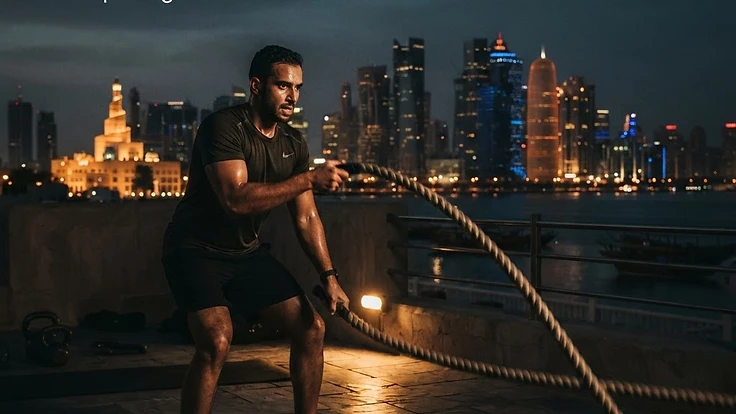
- Window 2: 2–3 Hours Post-Iftar (The Sweet Spot). Break your fast with water, dates, and a digestible meal (lean protein and complex carbs). Give digestion 90 to 120 minutes. Around 8:30 PM to 10:00 PM, your glycogen levels are replenished, blood volume is restored, and your central nervous system is ready for load. This is the optimal time for heavy barbell work, high-output conditioning, or combat sports.
- Window 3: Late Night (Midnight to Pre-Suhoor). Doha is uniquely built for night owls. Commercial gyms in Lusail and boutique spaces across West Bay stay lively until 2:00 AM or 3:00 AM. This window suits shift workers and late sleepers, giving you time to train, shower, and eat your Suhoor immediately after.
Matching Discipline to Venue: Strength and Conditioning
If you plan to maintain heavy compound lifts or high-volume conditioning, you need a facility that respects the post-Iftar schedule and provides serious coaching rather than generic circuits. Post-Iftar group training spikes the nervous system, so session efficiency is key.
Over in West Bay, specialized boutique facilities adjust their programming specifically to manage fatigue during the holy month. For high-output athletes balancing functional circuits, strength phases, and striking, check out View Ox Fitness Lab on Fitseeka →. They alter evening programming to emphasize shorter work-to-rest ratios, preventing excessive metabolic exhaustion when training after prayer.
If your focus leans into Hyrox, benchmark lifting, or structured strength and conditioning, View Pulso Fitness on Fitseeka → offers the high-end equipment and class layout needed to push performance without wasting valuable nighttime recovery hours.
Functional HIIT and Metabolic Management
High-Intensity Interval Training (HIIT) while fasted is a mistake. Dry fasting depletes intracellular water and plasma volume; redlining your heart rate without the ability to sip electrolytes dramatically spikes injury risk, cramps, and cortisol. Save the functional team workouts for after sunset.
For those living near Aspire Zone or Al Waab who thrive on fast-paced, 45-minute structured conditioning, View F45 Training Sports City on Fitseeka → gives you an intense, time-capped window that slots neatly between breaking the fast and late-evening Taraweeh prayers.
The Deload Alternative: Recovery and Mobility
Ramadan provides an ideal biological and psychological window for a structured deload. If you have been grinding through heavy weight cycles all winter, drop your working sets by 30 to 40 percent. Focus on range of motion, soft tissue quality, and nervous system down-regulation.
If you prefer an environment built around quiet precision, private movement sessions, or temperature-controlled recovery pools in the heart of downtown, consider View Mandarin Oriental Fitness Center on Fitseeka → in Msheireb Downtown Doha. Shifting your emphasis to deliberate mobility, restorative yoga, and swimming allows you to rebuild connective tissue while staying active.
Hydration Science for the Arabian Gulf Climate
Gulping two liters of tap water right before the dawn Adhan does not hydrate you; it simply stresses your kidneys and guarantees disrupted sleep within two hours. True cellular hydration is about absorption and retention over several hours.
- Ditch plain water boluses: Space your fluids between Iftar and Suhoor at roughly 350–500ml per hour.
- Electrolytes are mandatory: When fasting in Qatar's dry air-conditioned interiors or ambient coastal humidity, sodium loss remains steady. Add an unflavored electrolyte powder or a pinch of pink Himalayan rock salt and lemon to your water post-Iftar.
- Hydrating foods: Eat high-water content foods at Suhoor—cucumbers, watermelon, berries, and laban. The fiber slows water absorption, maintaining your hydration levels longer into the afternoon.
- Caffeine curfew: Cut off karak, espresso, and pre-workout drinks by midnight. Late caffeine intake shreds sleep quality, which is already precarious during Ramadan.
Suhoor and Iftar: The Real Fueling Strategy
The standard cultural pitfalls of Ramadan in Qatar—mountains of fried sambusas, sugar-soaked vimto, and heavy thareed—are disastrous for athletic recovery. You cannot recover from a heavy session on sugar spikes and trans fats.
Break the fast cleanly: Start with 2–3 dates and 400ml of room-temperature water with electrolytes. Follow with a light soup or a clean protein source (like grilled chicken breast or fish) and a moderate carbohydrate (jasmine rice, sweet potato). Keep fat low initially so your stomach empties efficiently before your workout.
Build Suhoor for sustained release: Suhoor is your metabolic anchor. Prioritize slow-digesting proteins like micellar casein, Greek yogurt, or eggs, combined with complex carbohydrates like rolled oats, chia seeds, and avocado. This steady-drip release of amino acids and glucose protects muscle tissue against catabolism during the heat of the following afternoon.
Adapt, Don't Stop
Ramadan in Qatar does not demand that you abandon the progress you built all year. It simply requires you to drop ego lifting, prioritize sleep, and adapt your routine to the city's midnight rhythm. Dial back your training volume by a third, schedule your hardest work two hours after Iftar, salt your water, and treat recovery as non-negotiable. Do that, and you will finish the month stronger, leaner, and sharper than when it started.