Fitness is often framed as a personal endeavour but cities can help nudge us into healthier lifestyles — even one built for 45°C summers and a car-first past. A cooled running track, a free national holiday, a bridge over a six-lane road: Doha has spent the past decade quietly building the infrastructure of an active city. Here, we chart ten schemes, spaces and quirks setting the pace across the capital.
1 — Beating the heat, literally
Air-conditioned tracks, Qatar-wide
Nothing says "we take this seriously" quite like refrigerating the outdoors. Rawdat Al Hamama Park now has the country's longest air-conditioned running track, at 1.2km, with Al Gharrafa Park (657 metres) and Umm Al Seneem Park (1.14km) close behind. Each is fitted with cooling systems built to hold a comfortable temperature through the peak of summer, letting joggers, sports academies and families train year-round instead of retreating indoors for four months. It is an eccentric-sounding fix, but a rational one: if the heat is the barrier to activity, engineer the heat away.
2 — An oxygen tank for the desert
Oxygen Park, Education City
Designed by AECOM for Qatar Foundation, this 130,000 sq m "green lung" uses the topography itself to fight the climate. A 1.6km track loops through sunken tunnels and covered walkways cooled by discreet air-conditioning, with hills and folds modelled on wind-eroded desert rock. Runners get shade, breeze and, after dark, string lighting and glowing balloon lamps that keep the park usable well past sunset — proof that a running track can also be a piece of landscape architecture.
3 — A whole country closes for a workout
National Sport Day, nationwide
Since 2012, Qatar has held a public holiday for the sole purpose of getting people moving. On the second Tuesday of every February, schools, offices and shops shut, roads around Education City go car-free, and parks, beaches and stadiums from the Corniche to Lusail Boulevard turn into free open-air gyms. This year's edition included a half-marathon along Lusail Boulevard, five "Fitness Box" smart outdoor-gym sites offering free strength equipment, and colour runs, padel and yoga sessions across dozens of venues. Few nations legislate for fitness quite this literally.
4 — Shade as infrastructure
Msheireb Downtown Doha
Built on the site of Doha's original commercial quarter, Msheireb was designed from the ground up as a walkable district: streets are narrowed and oriented to draw in cooling Gulf breezes, while colonnades, deep overhangs and recessed façades keep pedestrians in shade for most of the day. A free, step-free tram and dedicated cycle lanes reduce the need for cars altogether. It's a rare case of a Gulf megaproject prioritising the pedestrian over the car park — even if, researchers note, that comfort still stops abruptly at Msheireb's edges.
5 — Doha's original green lung
Aspire Park
At 88 hectares, this is the capital's biggest park, ringed by a 5km running and walking track and dotted with outdoor gym equipment, a lake, and shade from the Torch Tower looming above. Open 24 hours and free to enter, it sits inside Aspire Zone, the sporting campus built for the 2006 Asian Games, meaning a jog here comes with a backdrop of Olympic-grade stadiums. It remains the default answer to "where do you run in Doha?" for residents without a marina view on their doorstep.
6 — The 7km sofa with a view
Doha Corniche
The crescent-shaped promenade curling around West Bay has had a decade of quiet reinvention: repaved cycling and pedestrian lanes, palm-frond-shaped lighting nodding to Qatari heritage, and three new pedestrian tunnels linking Al Dafna, Corniche and West Bay stations to the waterfront without crossing traffic. The bike paths now connect through to Al Bidda Park and Theatre Park, stitching together green space along most of the bay. On a Friday morning, it functions as the city's unofficial running club.
7 — A promenade for the new city
Lusail Marina Promenade
North of Doha, Lusail's answer to the Corniche is a 3.5km waterfront path of cycle lanes, walking tracks and palm-lined stretches overlooking the Katara Towers and South Marina Yacht Club. Purpose-built rather than retrofitted, it was designed alongside the rest of Lusail's grid, with a light-rail line running beneath it and playgrounds and fountains built in from day one. It's cooler and quieter at dawn, and rather more of a scene after dark, when the lighting and fountains switch on.
8 — The rise of the padel court
Wherever there's a rooftop
Padel has gone from a niche hotel amenity to a fixture of everyday Doha life in under five years, driven by the Qatar Tennis, Squash, Padel and Badminton Federation and a calendar that now includes a Premier Padel Major at Khalifa International Tennis and Squash Complex. Courts have sprung up on mall rooftops, at beach clubs, inside Education City and along hotel waterfronts, with apps like Playtomic making a game easier to find than a parking space. For a sport that didn't exist here a decade ago, it has become one of the more reliable ways to meet the neighbours.
9 — Solving the last mile
Metrolink, e-scooters and the Doha Metro
A metro system is only as useful as the walk (or ride) at either end of it, and Doha has attacked that problem from several directions at once: a free Metrolink feeder-bus network covering a 2–5km radius around every station, an on-demand shared-van service called MetroExpress, and shared e-bikes and e-scooters from operators including Lime and Loop clustered outside stations such as Legtaifiya, West Bay, Katara and Lusail. Researchers tracking scooter GPS data found more than half of all trips began or ended within a short walk of a metro entrance — evidence the pieces are starting to click together.
10 — 1,808km and counting
Ashghal's pedestrian and cycling network
The unglamorous but decisive statistic behind all of the above: Qatar's Public Works Authority has laid more than 1,808km of dedicated pedestrian and cycling tracks since 2020, woven into new highways, main roads and residential streets rather than added as an afterthought. It's the kind of infrastructure that rarely makes a postcard, but it's what allows all the good intentions — the parks, the promenades, the padel courts — to actually connect to one another.
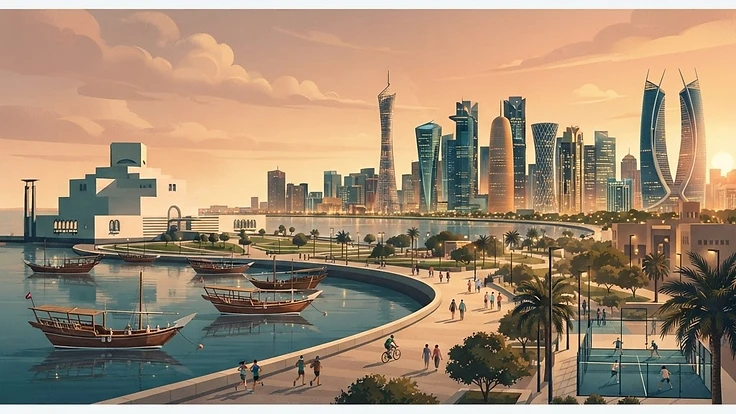
Illustrator brief: a Doha skyline sweep from the Corniche's dhows and Museum of Islamic Art through to the Torch Tower and Lusail's Katara Towers, with runners, cyclists and padel players threaded along the waterfront.