
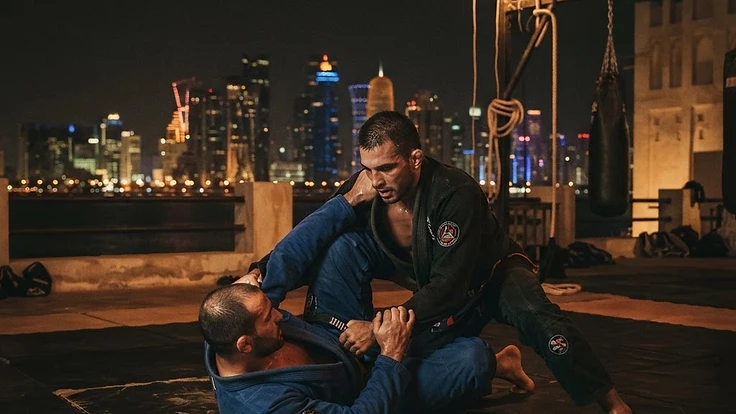
The Quiet Evolution on Qatar’s Mats
Step onto the mats inside an academy in Doha on any weekday evening, and you will not hear the clattering barbells or bass-heavy gym tracks common to commercial fitness clubs. You hear heavy breathing, the friction of woven cotton gis against canvas, and coaches barking tactical adjustments in a mix of Portuguese, Arabic, and English. Brazilian Jiu-Jitsu (BJJ)—frequently called the gentle art—has established a formidable home across the Gulf, and Qatar's grappling community has matured into one of the most vibrant martial arts subcultures in the country.
While neighboring Abu Dhabi made global headlines by integrating jiu-jitsu into schools and government sectors, Doha developed its grappling ecosystem organically. Today, practitioners range from Qatari nationals and corporate professionals commuting from West Bay to expatriate families residing in Lusail, The Pearl, and Al Wakrah. For athletes seeking complete physical competence, grappling provides the ultimate reality check.
The Landscape: Academies Shaping Doha's Mat Culture
Finding legitimate BJJ coaching in Doha was once an exercise in word-of-mouth recommendations among small expat groups. That era is long gone. The modern Doha landscape hosts affiliated schools led by internationally accredited black and brown belts who hold legitimate competition lineage.
Key outposts anchoring the city include:
- Checkmat Qatar: Operating with world-class tournament pedigrees, this powerhouse brings authentic Brazilian competition culture directly to the capital, running structured Gi and No-Gi curriculums for serious competitors and everyday practitioners alike.
- Jiu Jitsu Martial Arts Academy (JJMA Qatar): Renowned for establishing family-friendly roots, dedicated youth pathways, and women-only programs, JJMA brings technical grappling out to locations spanning Education City and Al Wakrah.
- UFC Gym Qatar: Combining mixed martial arts infrastructure with formal BJJ lineages overseen by senior black belt directorship, their high-performance facilities provide structured belt progression from white to black.
- Powerhouse Gym & Independent Clubs: Neighborhood hubs in Duhail, Ain Khaled, and Medina Centrale on The Pearl prove that high-level rolling is never more than a short drive away.
The Culture: Ego Left at the Door
BJJ functions as human chess under pressure. Unlike weightlifting or cardio sessions, you cannot fake competence against an uncooperative training partner trying to sweep, isolate, and submit your limbs. That dynamic creates an egoless culture unique to combat sports.
In Doha's academies, local executives, weekend hobbyists, and international competitors roll as equals. There are no hierarchy allowances for social status or job titles. If you leave your neck exposed to a guillotine choke, a teenage blue belt will tap you out without hesitation. This brutal honesty creates deep camaraderie. It is common to see training partners who were choking each other ten minutes earlier sitting together for karak or iced espresso in Msheireb Downtown or along the Lusail Marina.
Serious practitioners also recognize that longevity requires balanced physical maintenance. Rolling three or four nights a week places immense strain on the cervical spine, shoulders, and hip flexors. While you can sharpen your takedowns and guard passes on the mat, building joint resilience and raw pull strength requires focused conditioning. When taking active recovery days away from heavy grappling, many grapplers head to facilities like View W Doha FIT Gym on Fitseeka → for mobility work and functional conditioning, or step into View Global Gym on Fitseeka → to build foundational structural strength.
Surviving the Gulf Climate: Mats, Humidity, and Gi Life
Training combat sports in Doha presents logistical realities shaped directly by the desert climate. Between May and October, the humidity outside makes hydration and hygiene non-negotiable considerations.
A typical 90-minute session involving drilling and active sparring will saturate a heavy weave Gi completely. The golden rules of the Doha grappling community are strict:
- Hygiene is paramount: Wash your Gi and rashguard immediately after every single session. Never let a damp Gi bake in your car boot under the Doha sun, unless you want to ruin the fabric and bring bacteria onto your team's mats.
- Electrolyte discipline: Air conditioning keeps Doha's academies comfortable, but high-intensity grappling induces heavy sweat rates. Plain water is insufficient; replenishing sodium, magnesium, and potassium prevents debilitating cramps mid-round.
- Cross-training versatility: Even committed grapplers mix their training calendar. Balancing tactical mat hours with dedicated strength blocks at venues like View dans gyms on Fitseeka → gives athletes the endurance and posterior chain power necessary to break stubborn guards.
Women on the Mat: A Rapidly Growing Segment
One of the most notable developments in Qatar’s BJJ scene is the explosive growth of women-only grappling. Recognizing local cultural requirements, several academies, including JJMA and multi-branch facilities like Powerhouse Gym in Duhail, offer dedicated female-only slots coached by accomplished female instructors.
BJJ appeals heavily because it does not rely on brute size. Leverage, hip mobility, and angles allow smaller practitioners to manage and neutralize larger attackers effectively. For women in Doha looking for practical self-defence combined with an intensely functional workout, the mat has become an empowering alternative to standard boutique fitness classes.
The Bottom Line
BJJ strips away pretense. In a city filled with hyper-curated environments, stepping onto the mat demands total focus, honesty, and humility. Whether you are stepping through the doors of a dedicated academy or backing up your rolls with heavy deadlifts at View Back to fit gym on Fitseeka →, the gentle art will challenge how you move, think, and endure. Buy a Gi, step on the mat, and tap out your ego.