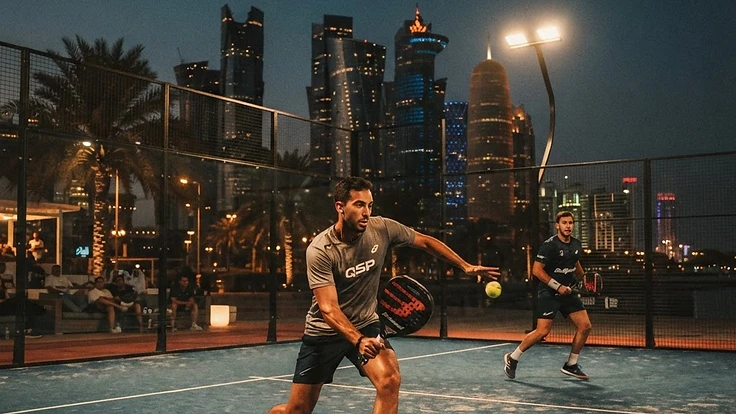
Drive past any major sports complex or luxury hotel in Doha after 7:00 PM, and you will hear it: the sharp, metallic thwack of solid rackets striking low-compression balls, followed immediately by shouting, laughter, and chatter. From the high-tech enclosures at Aspire Zone to glass-walled courts framed by West Bay's high-rises and waterfront spots across The Pearl, padel has evolved from a niche curiosity into Qatar's undisputed sporting obsession.
This is not hyperbole. According to data from the International Padel Federation (FIP), Qatar ranks among the top padel-playing nations globally and sits first in Asia, hosting the prestigious Ooredoo Qatar Major Premier Padel alongside dozens of domestic tournaments. But the real story is not just on the professional circuit—it is on the ground, where amateur courts are fully booked weeks ahead, late-night corporate leagues run until 2:00 AM, and everyone from former competitive tennis players to desk-bound professionals has picked up a racket.
Why Padel Took Over the Gulf
Padel's explosion across Doha is not an accident of marketing; it is a sport built specifically for how people live and socialize in the region. Unlike traditional tennis, which demands months of technical lessons just to sustain a modest rally, padel has an almost non-existent barrier to entry. Within twenty minutes on a court, four complete beginners can sustain long, dynamic exchanges.
A few structural factors explain why the sport clicked so deeply with Doha’s community:
- The Social Nature: Padel is almost exclusively played in doubles. The enclosed 10x20-meter court places teammates and opponents in close proximity, encouraging constant communication, tactical banter, and post-match café runs—often dubbed the game's essential "third half."
- Weather Resilience: While outdoor sports become unplayable during Doha's summer months, operators recognized early on that high-ceilinged, air-conditioned indoor facilities could turn padel into a 365-day obsession.
- The Strategic Curve: The glass walls turn defensive plays into chess matches. Raw power rarely wins a point; angles, patience, and footwork do. That makes it intensely addictive for athletes of every background.
Where to Play: Doha's Top Padel Hubs
Whether you want top-tier indoor climate control or a scenic match by the beach, Doha has over 150 courts spread across more than 40 dedicated clubs and resorts.
PADEL IN (Aspire Zone, City Center, & Sealine): Founded by local pioneer Mohammed Saadon Al Kuwari, PADEL IN Aspire stands out as one of the largest indoor padel venues in Asia and Africa, housing 13 courts under one roof. It is the gold standard for competitive local tournaments and organized league play.
Education City (The Dome Padel Club): Qatar Foundation's dedicated venue offers both indoor and outdoor options. Known for an open, community-first atmosphere, it provides coaching clinics for juniors and adult leagues in an academic, active environment.
Luxury Waterfront Venues: If you prefer outdoor play during the pleasant winter months (November to April), stunning beachfront courts are hosted across 5-star properties like Marsa Malaz Kempinski at The Pearl, The St. Regis Doha, and the Waldorf Astoria Lusail.
Boutique Indoor Facilities: As demand continues to surge across peripheral residential hubs, independent venues such as 10x20 Padel in Thumama have stepped up to provide tournament-standard Spanish turf, solid coaching clinics, and high ceilings within easy reach of neighborhoods south of the E-Ring.
The Fitness Reality: Fun is Not a Complete Regimen
Padel is fantastic for cardiovascular endurance, lateral agility, and hand-eye coordination. A hard 90-minute match burns between 600 and 900 calories, and because the game moves fast, your heart rate spends significant time in zones 3 and 4 without the monotony of running a treadmill along the Corniche.
However, many players fall into the trap of using padel as their only form of exercise. Because padel relies on short, explosive bursts, rotational trunk twisting, and frequent eccentric braking on synthetic turf, it places intense asymmetric stress on the knees, Achilles tendons, lower back, and dominant shoulder.
If you want to play three to four times a week without picking up chronic tendonitis or hamstring strains, you need dedicated resistance work off the court.
Cross-Training for Padel: Where to Build Durability
To hit harder smashes and recover quickly without injury, balance your court time with functional strength, core stability, and unilateral training.
If you play or live near Lusail, build your functional base at a facility equipped for high-performance cross-training. View Gymmito Fitness Club (Lusail) on Fitseeka → to work on the lateral strength and rotational power your overheads demand.
For those located in central Doha looking for holistic conditioning, mobility, and swimming recovery to decompress spinal loading after competitive sets, explore options at View M Active Club on Fitseeka →.
If you are based around The Pearl and need a structured routine combining targeted kettlebell power with yoga to keep your hips and thoracic spine mobile, View Gymmito Fitness Club (The Pearl) on Fitseeka →.
Lastly, if recurring shoulder tightness or lower back tweaks are slowing your game, deliberate reformer work and functional stability can safeguard your joints; consider booking a session through View Life+ Health Club on Fitseeka →.
How to Get Started Without Overthinking It
If you have never touched a racket, you do not need expensive gear to begin. Most clubs in Doha offer racket rentals for QAR 20–30 per session. Book a beginner court with three friends during non-peak hours (weekday mornings or early afternoons) to get comfortable with the ball rebound off the back glass.
Download local booking platforms like Playtomic to locate open court slots, find matches at your skill tier, and discover local community ladders. Padel is here to stay in Qatar—get on the court, find your rhythm, and back it up with proper training.