
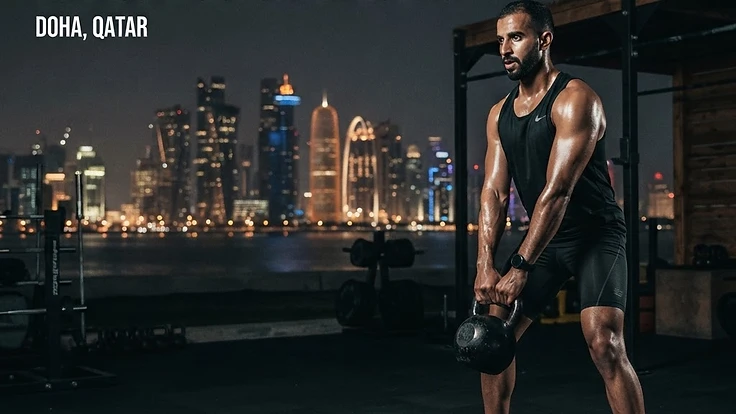
Linear progress is a rookie illusion. When you first start lifting, every week feels like a PR: add five kilograms to the bar, run slightly faster, rinse, repeat. But six months in, the wheels come off. Joints begin to ache, progress grinds to a halt, and motivation plummets. In a city like Doha, where external stressors shift dramatically between blistering summer lockdowns and outdoor winter racing seasons, pushing at 100% year-round is a direct route to chronic fatigue.
If you want sustained progress, you need periodization: the systematic sequencing of training variables over time. Instead of showing up to the rack and working until exhaustion every day, an annual plan divides your calendar into deliberate phases—hypertrophy, maximal strength, metabolic conditioning, and structured deloads. Here is how to build a 12-month periodized training model adapted to the climate, calendar, and lifestyle of Qatar.
The Core Hierarchy: Macrocycles, Mesocycles, and Microcycles
Periodization operates across three distinct planning tiers:
- Macrocycle: Your overall annual roadmap (usually 52 weeks), anchored to one or two primary performance peaks.
- Mesocycle: Focused blocks lasting between 3 to 6 weeks, each prioritizing one specific adaptation, such as base hypertrophy, absolute strength, or peak power output.
- Microcycle: The shortest operational unit, typically a single week, organizing daily workouts, volume distribution, and rest days.
In Doha, your macrocycle cannot look like an annual plan written for Northern Europe. Your macrocycle must bend around three non-negotiables: the scorching summer months from June through September, the optimal outdoor weather running from November through March, and the annual shifting rhythm of Ramadan.
Phase 1: Summer Base and Hypertrophy (June to September)
When midday temperatures consistently cross 45°C, high-intensity outdoor conditioning is off the table. Daylight hours belong to climate-controlled spaces, making this four-month window prime real estate for high-volume hypertrophy and structural reinforcement.
Hypertrophy blocks require accumulated volume—moderate loads (65–75% of 1RM) across 8–15 rep sets—without needing top-end neurological output. Because you spend minimal energy outdoors, you can channel all recovery capacity into building muscle tissue and reinforcing joints indoors. Venues like View Andaz Doha Fitness Centre on Fitseeka → in West Bay provide the dedicated strength machines and air-conditioned floor space necessary to rack up high weekly tonnage without heat strain.
Structure this block into three 4-week mesocycles (each consisting of 3 loading weeks followed by 1 deload). Use this phase to fix nagging imbalances, build tissue resilience, and keep cardiovascular conditioning inside via rowers, ski ergs, and indoor tracks.
Phase 2: Autumn Strength Transition (October to November)
As the humidity breaks in late October, transition your mesocycles toward absolute strength and nervous system efficiency. Reduce set volume by roughly 30% and push intensity up to 80–90% of your 1RM, dropping repetitions into the 3–6 rep bracket on compound staples: squats, deadlifts, and overhead presses.
For those preparing for local hybrid fitness competitions or winter sporting events, this is the time to blend raw strength with higher-threshold power. Boutique athletic hubs such as View Pulso Fitness on Fitseeka → offer structured Hyrox and functional conditioning programs designed to test how well that summer-built muscle can produce sustained output.
Phase 3: Winter Performance and Outdoor Peak (December to February)
Winter in Doha is brief, crisp, and high-energy. Between 5k and 10k road races at Aspire Zone, cycling circuits around Lusail, and long morning sessions along the Corniche or Katara, your active leisure time spikes naturally. Consequently, your gym training must reflect this shift in total physical workload.
During winter, transition your lifting into a maintenance or high-velocity power phase. Drop your lifting frequency to 2 or 3 focused sessions per week, preserving your top-end strength while freeing up recovery reserves for outdoor sport and track work. If you try to maintain peak lifting volume while simultaneously racking up miles around Education City or the Pearl, you will bury your central nervous system within four weeks.
Phase 4: Spring Reset and Active Recovery (March to May)
Spring serves as your bridge season. After heavy winter efforts, scale back the neurological intensity. Focus on functional strength, unilateral work, and rotational power. Facilities like View M|FIT Fitness Center (Alwadi MGallery) on Fitseeka → in Msheireb or View Al Messila Health Club on Fitseeka → allow you to incorporate restorative yoga, mobility-focused functional training, and steady-state sessions without redlining.
If you are fasting during Ramadan, this block should naturally become a strict maintenance mesocycle. Dial training intensity back to 70%, halve total working sets, and train either directly before Iftar or two hours after your first meal. Never attempt a maximal strength peak or PR cycle while in a severe fluid deficit.
The Deload: The Most Ignored Weapon in Doha Gyms
According to an international consensus paper published in Sports Medicine - Open, deloading is defined as a planned period of reduced training stress designed to alleviate physical and psychological fatigue while preparing an athlete for higher loads ahead. Survey data reveals that competitive strength athletes typically deload every 5 to 6 weeks for roughly 6 days.
Most gymgoers skip deloads until an inflamed tendon or an illness forces a week off. Instead, take a proactive deload at the end of every 3-to-5-week mesocycle using one of two practical methods:
- Volume Deload: Keep the weight on the bar identical to your working weights, but cut your total sets in half (e.g., from 4 sets of 6 reps to 2 sets of 6 reps). This retains neurological adaptations without generating fatigue.
- Intensity Deload: Maintain normal sets and repetitions, but drop your loads by 15–20%. This flushes blood through connective tissues while giving your nervous system a full reset.
Executing the Doha Microcycle
Your weekly layout must match local reality. In Qatar, the standard workweek runs Sunday through Thursday, leaving Friday and Saturday as weekend rest days. Take advantage of this natural cadence:
- Sunday: Heavy Lower Body (Highest energy after the weekend).
- Monday: Heavy Upper Body.
- Tuesday: Rest, light walk, or low-intensity mobility.
- Wednesday: Hypertrophy / Secondary Compound movements.
- Thursday: Functional conditioning or high-intensity capacity work.
- Friday: Early morning outdoor long session (Corniche, Aspire, or coastal Lusail before the sun peaks).
- Saturday: Full rest and passive recovery.
Stop Guessing, Start Mapping
Training hard is easy; anyone can walk into an air-conditioned gym, lift until they are sweating through their shirt, and leave feeling accomplished. But random effort produces random results. If you want a stronger, leaner, and more capable body three years from now, map out your training year today. Match your heavy building phases to the brutal summer months, harness the winter for performance and conditioning, respect your deload weeks, and let progressive periodization do the heavy lifting.