
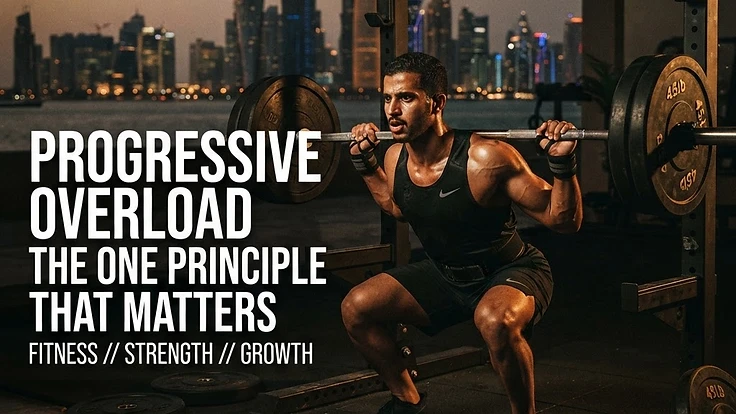
Walk into any gym in Doha at 7:00 PM on a Tuesday, and you will see the same script playing out. In West Bay hotel gyms, Al Sadd commercial facilities, and boutique studios along the Pearl-Qatar, trainees load the same dumbbells, run through the identical three sets of ten, and wipe down the bench feeling accomplished. Six months later, their physique looks identical, their bench press has not moved a kilogram, and they wonder why their subscription feels like an unproductive monthly tax. The issue is not their effort, their supplements, or whether they drink enough karak. It is that they are ignoring the single foundational law of resistance training: progressive overload.
The Biology: Why Your Body Refuses to Change for Free
Your muscles do not care about your fitness resolutions or how much you paid for your gym pass. Muscle tissue is metabolically expensive; the human body resists adding or maintaining it unless survival demands it. When you lift a weight, you impose mechanical tension and cellular stress on muscle fibres. Given adequate fuel and sleep, the body adapts by repairing those fibres to be marginally thicker and stronger—a phenomenon known biologically as supercompensation. But once your neuromuscular system adapts to bench pressing 60 kilograms for eight reps, that load ceases to be a crisis. It becomes baseline maintenance. Without an incremental increase in physiological demand, adaptation completely halts, leading directly to the classic plateau.
The Five Levers of Overload (It Is Not Just Adding Plates)
Most lifters make the mistake of assuming progressive overload solely means slapping heavier iron onto the barbell each week. In reality, linear weight progression hits a hard wall very quickly. If you added 2.5 kg to your squat every single week, you would theoretically squat 130 kg more within a year—an impossibility for natural trainees. To drive consistent results without shredding your joints, you have five distinct levers to manipulate:
- Absolute Load: Adding weight to the bar or grabbing the next dumbbell up (e.g., advancing from 16 kg to 18 kg on a dumbbell overhead press).
- Repetitions: Performing more reps with identical weight and pristine form (e.g., hitting 3 sets of 10 instead of 3 sets of 8 with 50 kg).
- Set Volume: Adding a clean working set to increase total tonnage (e.g., moving from 3 working sets to 4 working sets across your training block).
- Rest Intervals: Decreasing the recovery period between sets while holding load and reps steady, demanding greater metabolic efficiency.
- Execution and Tempo: Slowing down the eccentric phase (lowering the weight over three controlled seconds) or pausing at the bottom of a lift to eradicate momentum.
If you are pushing through functional workouts at View Pulso Fitness on Fitseeka →, overload might look like shaving twenty seconds off your circuit intervals or holding a clean cadence on your compound lifts rather than simply fighting for maximum poundage.
The Double Progression Method: The Lifter’s Best Safeguard
The cleanest, most dependable framework for the everyday trainee is double progression. Instead of chasing a fixed rep count, work within a target bracket—typically 8 to 12 reps for upper body hypertrophy, or 6 to 10 reps for compound lower body work. You keep the weight constant across all sets until you hit the ceiling of the repetition bracket on every single set with crisp form. Only then do you earn the right to advance the load.
For example, suppose you are doing dumbbell chest presses at View W Doha FIT Gym on Fitseeka → using 22 kg dumbbells:
- Week 1: Set 1: 10 reps | Set 2: 9 reps | Set 3: 8 reps
- Week 2: Set 1: 11 reps | Set 2: 10 reps | Set 3: 9 reps
- Week 3: Set 1: 12 reps | Set 2: 11 reps | Set 3: 10 reps
- Week 4: Set 1: 12 reps | Set 2: 12 reps | Set 3: 12 reps
Once you nail 3 sets of 12 with pristine form, you promote yourself to the 24 kg pair for your next session. Your rep count will naturally drop back toward 8 reps, and you repeat the climb. This method prevents ego-lifting, spares your connective tissue, and guarantees that progression is genuine rather than sloppy.
How to Track: Kill the Mental Guesswork
You cannot manage what you do not measure. If you enter the weights room trying to remember what you dumbbell pressed three weeks ago while simultaneously checking WhatsApp messages, you are not training; you are just exercising. Buy a cheap pocket notebook or use simple smartphone logging tools like Strong, Hevy, or your native Notes app. Document three data points for every working set: the movement, the exact weight, and the reps performed to technical completion.
If you split your week between hotel gym setups around Al Rayyan—such as sessions at the View Warwick Doha Fitness Centre on Fitseeka →—and outdoor conditioning along the Lusail Marina, having documented benchmarks is essential. Different machines have varying cable tensions and pulley ratios, so record the exact machine or pin setting. Consistency in measurement drives consistency in results.
The Doha Factor: Heat, Recovery, and Seasonal Plateaus
Progressive overload is an equation that requires biological recovery to function. Imposing stress without systemic recovery yields regression and injury, not growth. Living in Qatar introduces specific environmental bottlenecks that directly impair recovery capacity:
- Dehydration and Electrolyte Depletion: Even if you train inside climate-controlled facilities, stepping outside into 45°C summer heat in Msheireb or Al Sadd rapidly accelerates dehydration. A 2% dip in hydration can slash muscular force output by up to 10–15%. Keep your water and sodium intake dialled before entering the gym.
- Interrupted Sleep Schedules: Late-night socialising, dining past 10:00 PM, and early office hours severely reduce deep sleep stages where growth hormone surges. If you sleep five fractured hours a night, your nervous system cannot adapt to progressive demands.
- Air-Conditioned Lethargy: Moving constantly between chilled indoor air and harsh outdoor heat can mask true systemic fatigue. Listen to your warmup sets.
If you hit a wall where weights feel leaden for two consecutive weeks, you do not need more pre-workout. You need a planned deload. Cut your volume by 40% for seven days, focus on technique, or head to the sports recovery hubs near Aspire Zone—including amenities at View The Torch Doha Fitness Centre on Fitseeka →—to allow accumulated systemic fatigue to dissipate.
Stop Exercising, Start Training
The difference between exercising and training is intentionality. Exercise burns calories and keeps you moving; training pursues a defined physical outcome through calculated, incremental adaptation. Pick three to four core compound exercises, write down your starting numbers, and demand one extra repetition or one fractional kilo of progress from your body every session. Stick to that standard for twelve uninterrupted weeks, and the plateau takes care of itself.