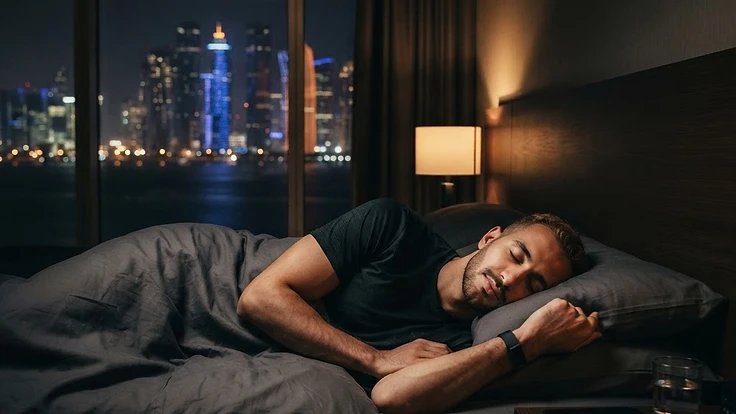
You just spent ninety minutes grinding through heavy deadlifts or intervals, downed your post-workout whey, and scheduled your next session. But if you crawl into bed at 1:00 AM, scroll social media under blue light, and wake up six hours later feeling like you were hit by a Land Cruiser on the Doha Expressway, you left half your gains on the table. Sleep is not passive downtime. It is an active, biochemically demanding biological state where muscle tissue repairs, growth hormone peaks, and your nervous system resets.
Sports medicine consensus from the British Journal of Sports Medicine confirms what elite strength and conditioning coaches preach: sleep extension boosts power output, sprint times, reaction speed, and injury resilience. Yet living in Qatar presents a specific set of challenges to quality rest. Late-night social habits, midnight padel tournaments, karak runs, blistering summer heat, and floor-to-ceiling glass towers in West Bay and Lusail all conspire against your circadian rhythm. If you want to perform, you need a strategy tailored to Doha life.
The Biological Mechanism: What Happens When You Actually Sleep
During Non-Rapid Eye Movement (NREM) deep sleep—specifically Stage 3 slow-wave sleep—your blood pressure drops, breathing steadies, and your pituitary gland releases up to 70% of your daily pulse of human growth hormone (HGH). This hormone orchestrates protein synthesis, repairing micro-tears in muscle fibers and rebuilding glycogen stores. Skip this window, and cortisol stays elevated, prompting muscle breakdown and impairing glucose metabolism.
Equally critical is Rapid Eye Movement (REM) sleep, which consolidates motor patterns. When you drill a complex Olympic lift, clean up your boxing footwork, or practice pacing splits, REM sleep is where those neural pathways lock in. If you are training hard at a performance-driven gym like View Pulso Fitness on Fitseeka →, skimping on restorative rest means you show up to Hyrox or strength conditioning running on neurological fumes.
The Doha Circadian Dilemma: Late Nights and Midnight Workouts
Doha runs late. In the cooler winter months, dinners in Msheireb Downtown or along the Pearl marina stretch past midnight. In peak summer, outdoor runs along the Corniche or Lusail Marina happen after 9:00 PM simply to dodge the humidity. Add in 11:00 PM indoor padel matches or heavy lifting sessions, and your nervous system stays jacked when it should be downshifting.
Vigorous training elevates core body temperature and spikes adrenaline and cortisol. To initiate sleep, your core body temperature must drop by roughly 1°C. If you finish intense intervals at 10:30 PM, do not expect to sleep deeply at 11:30 PM. Keep high-intensity metabolic work, heavy compounds, and intense cardio earlier in the day. If evening sessions are unavoidable, focus on controlled mobility, breathwork, or deliberate active recovery routines like those offered at View Al Messila Health Club on Fitseeka → to help trigger your parasympathetic nervous system before heading home.
Dialing in the Doha Sleep Cave
Your bedroom environment dictates your sleep architecture. In Qatar, three variables ruin sleep faster than anything else: temperature, artificial light, and dry indoor air.
- Drop the thermostat to 18–20°C: Central cooling in modern apartments across West Bay and Lusail can easily handle lower temperatures. Keeping your room cool signals your hypothalamus to produce melatonin. Sleeping warm fractures deep sleep stages and causes micro-arousals you might not even remember.
- Invest in real blackout solutions: Floor-to-ceiling glass looks sleek, but the sunrise over the Arabian Gulf will blast your retinas before 5:00 AM in the summer. Ambient street glare from city towers is just as disruptive. Fit heavy blackout curtains or use a contoured eye mask that creates 100% darkness.
- Tame the indoor humidity: Continuous air conditioning dries out mucus membranes, causing shallow mouth-breathing and nighttime awakenings. A clean ultrasonic humidifier next to your bed keeps airways lubricated and reduces respiratory strain.
The Caffeine and Karak Cut-Off
Caffeine has an average half-life of five to seven hours and a quarter-life of up to twelve hours. If you grab an afternoon double espresso in Education City or split a pot of strong karak after work, a quarter of that stimulant is still binding to adenosine receptors in your brain at midnight. You might manage to fall asleep, but caffeine crushes restorative slow-wave sleep.
Draw a hard line: no stimulants past 2:00 PM. If you need a pre-workout kick for an evening session, skip the high-stim powders loaded with 350mg of caffeine anhydrous. Choose non-stimulant options rich in citrulline malate and electrolytes, or rely on a proper warm-up to generate energy.
Strategic Napping: The Middle East Advantage
The traditional afternoon rest common in hot climates is supported by sports science. A 20-to-30-minute nap between 1:00 PM and 3:00 PM can clear homeostatic sleep pressure, lower resting heart rate, and restore cognitive sharpness without interfering with nighttime sleep.
Keep naps under thirty minutes to avoid entering slow-wave sleep, which leaves you groggy. If you train twice daily or fit your workouts into early mornings before work, an afternoon reset is an effective training tool.
Building an Uncompromising Evening Routine
Consistency anchors your circadian clock. Going to bed at 10:30 PM on Tuesday and 2:30 AM on Thursday throws your body into social jet lag. Treat your bedtime with the same discipline you apply to training programs at boutique conditioning spaces like View Life+ Health Club on Fitseeka →.
- Ditch screens 45 minutes before lights out: Blue light from phones, tablets, and laptops suppresses melatonin synthesis. Switch your devices to night mode by sunset and read physical pages instead.
- Take a hot shower 60 minutes before bed: Stepping out of hot water into a cool bedroom causes rapid vasodilation, dumping heat from your core and speeding up sleep onset.
- Hydrate early, not late: Gulping a liter of water right before bed guarantees 3:00 AM bathroom trips. Hydrate steadily throughout the day and taper off fluid intake after dinner.
- Incorporate evening mobility: If you take high-energy boxing or reformer sessions at spots like View The Venue Ladies on Fitseeka →, dedicate ten minutes before bed to foam rolling, hamstring stretching, and slow nasal breathing to downregulate central nervous system arousal.
Bottom Line
You do not grow in the gym; you break down tissue. You grow when you sleep. Cut the late-night doomscrolling, drop your bedroom temperature, set a strict caffeine curfew, and give your body the seven to nine hours of quality rest it requires. Treat sleep like your most important workout of the day.