The Post-Tournament Reality Check
When the fireworks cleared over Lusail Stadium in December 2022, critics predicted a desert wasteland of white-elephant venues and empty pitches. Qatar had spent over a decade constructing one of the most sophisticated sporting footprints on earth. The cynical expectation was simple: the caravan would move on, leaving Doha with air-conditioned monuments to an eight-week party.
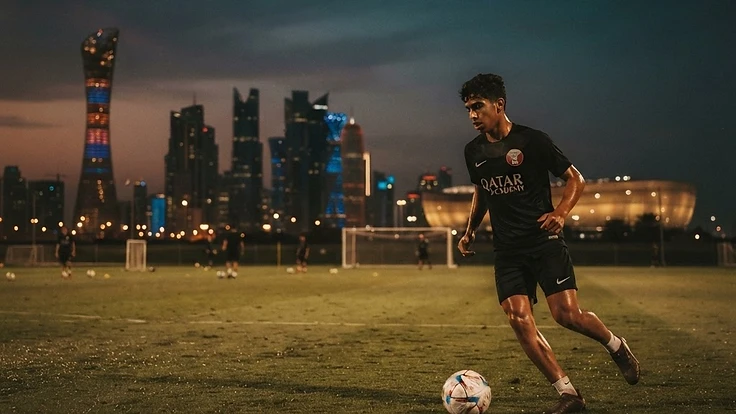
That prediction missed how modern football infrastructure works. Walk around Education City on a weekday evening, check the pitch bookings near Al Janoub in Al Wakrah, or observe the indoor sessions at Aspire Zone. The stadiums did not shutter. Instead, the focus pivoted hard from hosting global superstars to fixing the domestic talent engine.
The Dual Track: Elite Academies vs. Everyday Community Grassroots
Football in Qatar operates on two distinct tracks. At the pinnacle sits Aspire Academy in Al Rayyan. For nearly two decades, Aspire scouted rigorously and centralised national talent, producing the backbone of the squad that won back-to-back AFC Asian Cups in 2019 and 2023. But elite residential development only touches dozens of boys at a time. The post-2022 mandate is broader: turning an expat-heavy, sedentary population into an active community that actually plays the game.
Private academies have multiplied across The Pearl, West Bay, and Lusail. Programmes catering to youth from ages four to eighteen now occupy international school pitches every night from October through May. These aren't just babysitting clinics with bibs; UEFA-licensed coaches run high-repetition technical drills, feeding private youth leagues that didn't exist five years ago.
The Stadium Dilemma: How the World Cup Venues Function Now
Repurposing tournament stadiums is football’s historic sticking point. Qatar tackled this by integrating venues into domestic competitions and high-profile regional hostings like the AFC Asian Cup and the FIFA U-17 World Cup. Venues such as Ahmad Bin Ali Stadium in Al Rayyan and Al Bayt in Al Khor regularly stage Qatar Stars League (QSL) matches.
More importantly, the precincts surrounding them were turned into public running tracks, outdoor gyms, and five-a-side community cages. Education City Stadium embedded its surrounding greenspaces into university life. The precincts in Al Thumama and Al Wakrah are packed with local five-a-side matches under floodlights as soon as the sun dips below the horizon.
Physical Conditioning: What Amateur and Semi-Pro Players Need Here
Playing competitive football in the Gulf presents unique physiological challenges. Between November and March, outdoor conditions are ideal. From May to September, ambient heat and humidity turn full-field football into an endurance trap that wrecks unconditioned athletes. If you play in Doha's adult leagues or weekend 7-a-sides, pitch performance demands smart off-field strength and conditioning.
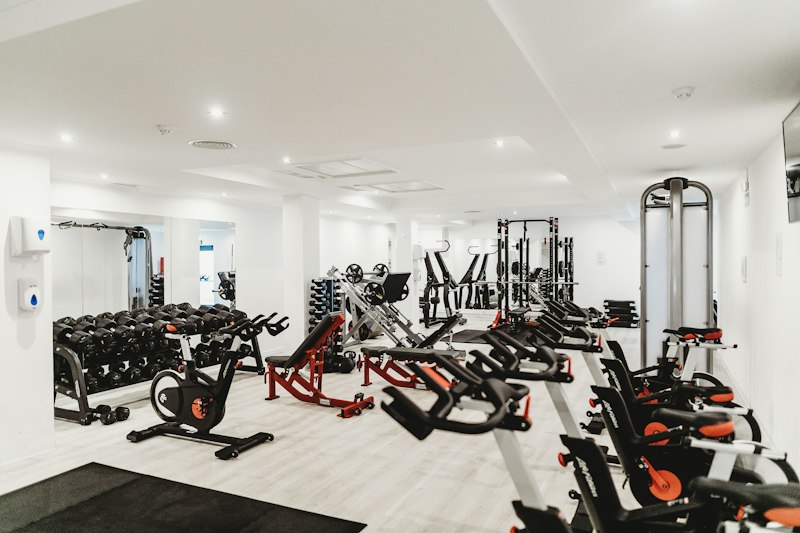
Footballers here suffer when they rely purely on open-play running. Sprint-repeat ability and hamstring deceleration require serious barbell and plyometric work. If you want to build the explosive power and durability necessary to survive 90 minutes on synthetic turf, check out functional conditioning setups like View Pulso Fitness on Fitseeka → to balance your field sessions with high-intensity interval capacity.
For structured group training that mirrors football's energy demands—rapid short bursts coupled with minimal rest—amateurs in Al Waab and Sports City turn to high-intensity functional intervals. You can test your engine at View F45 Training Sports City on Fitseeka → right next to the country's sporting epicenter.
Closing the Gender Gap in Domestic Football
Historically, football development in the Gulf was exclusively male. The post-2022 era has seen noticeable, deliberate shifts. School leagues for girls have expanded, private academies now run dedicated female squads, and grassroots women's leagues play across university pitches in Education City.
Facility access was the long-standing bottleneck. Spaces offering privacy, top-tier coaching, and dedicated female recovery environments are changing that landscape. Female athletes looking for athletic conditioning, movement mobility, and low-impact cross-training frequently utilise specialized sports hubs like View Aspire Active Ladies on Fitseeka → in Al Rayyan, demonstrating how the wider Aspire ecosystem serves the community well beyond national squad camps.
Recovery and Longevity in Qatar's Climate
Playing two or three matches a week on 3G and 4G artificial turf—which comprises 90% of amateur surfaces in Doha—takes a heavy toll on knees, adductors, and lower backs. When the summer heat forces games into indoor sports halls or late-night outdoor slots, dehydration and soft-tissue tightness spike dramatically.
Smart players prioritize active recovery: mobility circuits, contrast hydrotherapy, and dedicated mobility sessions. If your routine lacks elite-level recovery protocols, utilizing comprehensive facilities like the View Mandarin Oriental Fitness Center on Fitseeka → in Msheireb Downtown provides access to temperature-controlled lap pools and targeted physical therapies that keep soft tissue resilient against turf burn and fatigue injuries.
The Verdict: An Ecosystem Taking Root
Qatar's football development is no longer judged solely by how many foreign superstars sign short-term contracts in the Qatar Stars League. The real measure is taking shape on the pitches running along the Corniche, behind the community gates of The Pearl, and inside the modern athletic zones of Lusail. The infrastructure was built for the world; now, it finally belongs to the people who live here.