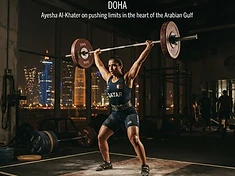

Going to the gym alone in Doha requires a rare level of personal discipline. You drive through rush-hour traffic on the Corniche or navigate the evening congestion around West Bay, hunt for parking, plug in your headphones, and stare down a row of identical cable stations. Most people last three weeks before convenience wins, the routine drops off, and their gym access turns into an unused direct debit.
Fitness psychology has repeatedly verified what coaches on the ground already know: human beings are social animals, and self-directed exercise carries the highest drop-off rate of any physical training model. When you work out alone, nobody notices if you cut your third set short or decide to skip Thursday entirely. In contrast, group fitness creates an ecosystem of shared struggle, positive social friction, and behavioral adherence that lone sessions simply cannot replicate.
The Köhler Effect and the Science of Group Training
Sports psychologists refer to the boost in individual output during shared workouts as the Köhler Effect. Put simply, people perform better and push harder when working out alongside peers than when exercising alone. Seeing the person next to you hold their barbell or maintain pace on the SkiErg triggers a subconscious drive to persist.
A review published in the National Library of Medicine points out that social belonging, shared group identity, and instructor dynamics serve as primary drivers for physical activity adherence. It is not just about competing; it is about collective accountability. In a city like Doha, where expatriates make up a massive percentage of the working population, that sense of common effort bridges cultures and breaks the isolation of corporate life.
The Doha Reality: Climate and Social Friction
Training in Qatar presents distinct physical constraints. From late May through September, outdoor running at Aspire Park or along the Lusail Marina becomes practically unviable for conditioning. Everyone moves indoors. Air-conditioned gym floors can feel sterile and detached when you are wandering through isolated dumbbell routines.
Structured group classes solve this friction by taking decision fatigue off the table. You book a slot, you turn up, the coach dictates the stimulus, and you complete the work with twenty other people who showed up for the exact same reason. In neighborhoods like The Pearl and Lusail, group classes have evolved from casual spin sessions into technical, high-output environments. Boutiques like View Pulso Fitness on Fitseeka → cater directly to this shift, pairing structured functional training, Pilates, and Hyrox preparation with high-energy coaching that keeps members anchored to their goals through every season.
Accountability Over Motivation
Motivation is fleeting. It evaporates when your alarm sounds at 5:30 AM before a shift in West Bay, or when an afternoon meeting in Msheireb Downtown runs late. Accountability is systemic. When the head coach and the regular crew at your gym expect to see you at the 6:00 PM session, skipping it requires an active decision to let down your squad.
This peer accountability is the driving force behind modern strength and conditioning spaces. At facilities like View only1 fitness on Fitseeka →, members are not just showing up for arbitrary circuits; they train through dedicated CrossFit, calisthenics, and Hyrox programming where partners count reps and track split times together. The dynamic removes loneliness from intense training and substitutes it with camaraderie.
Community Accessibility Across Doha’s Neighborhoods
Community training does not need to be locked behind exclusive boutique studios. Accessibility matters just as much. For residents living outside the commercial towers—across areas like Al Mansoura, Najma, and the southern districts—neighborhood gyms provide a stable everyday anchor.
Established hubs like View Anytime Fitness (Bin Mahmoud) on Fitseeka → and its counterpart View Anytime Fitness (Al Hilal) on Fitseeka → bridge the gap between traditional gym floors and coach-led group classes. Having daily instructor-led group programming embedded into local, round-the-clock facilities ensures members do not need to travel across town to find structured training partners.
What to Look for in a Doha Group Fitness Class
Not all group fitness delivers results. If a class consists of chaotic choreography with sixty people crammed into a studio while an instructor screams into a headset, you are buying entertainment, not progress. To get lasting results, choose group programs that emphasize:
- Structured progression: Classes should follow clear strength, aerobic, or hybrid training cycles rather than random exercise selection.
- Coaching oversight: Instructors must actively correct form, scale movements for beginners, and adjust loads rather than just performing on a platform.
- Appropriate capacity: Smaller cohort sizes prevent overcrowding and ensure equipment like rowers, barbells, and sleds are safely distributed.
- Culture over clout: Look for spaces where members greet newcomers, support each other during the final rounds, and stick around after the cooldown.
Stop Training in a Silo
Solo training has its place when you are testing maxes or following an ultra-specific individual program. But if your goal is long-term adherence, consistent effort, and enjoying the process in Doha, training alone is the hardest path to take. Pick a room, find your crew, and let community do the heavy lifting.