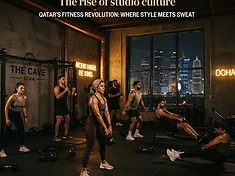
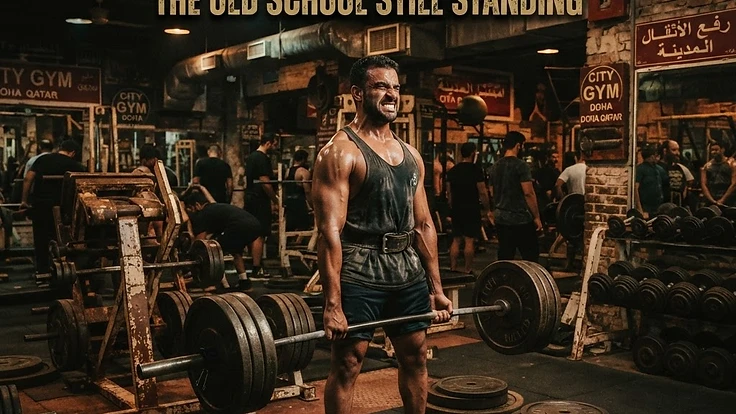
Walk into a fitness space in West Bay or The Pearl at 6:00 PM, and you will encounter a familiar tableau: ambient ring lights, bespoke scent diffusers, rows of identical high-tech screens, and members nervously sidestepping tripods. The modern boutique fitness scene has made exercise comfortable, sanitized, and cinematic. But if you take a detour off the B-Ring Road into Najma or negotiate the tight parking of Mansoura, you enter an entirely different world: a world built on cast iron, peeling vinyl, chalk dust, and serious volume.
This is the domain of City Gym. Long before private equity groups and mega-clubs began selling lifestyle packages across Lusail and Msheireb, places like City Gym formed the bedrock of competitive lifting and grassroots strength in Qatar. It remains an unapologetic bastion of heritage lifting culture.
The Heritage Footprint: Mansoura, Najma, and Beyond
Founded when Doha’s fitness ecosystem was still largely defined by localized neighborhood rec centres and expat clubs, City Gym established itself where the city lived and worked. Forget waterfront promenades and marina drop-offs. The chain built its presence in dense urban corridors like Ibn Dirhem Street in Mansoura and near the historic B-Ring intersections in Najma.
To understand the enduring popularity of View City Gym (Najma) on Fitseeka →, you need to understand old-school gym culture globally—from Temple Gym in Birmingham to the legendary dungeons of Metroflex in Texas. These gyms were never designed as wellness social clubs. They were functional utility rooms where mechanical tension met human effort. City Gym brings that identical philosophy to the heart of Doha.
Over the years, the brand expanded across Qatar's urban grid, planting flags in Al Wakrah, Abu Hamour, and through facilities like View City Gym (Mansoura) on Fitseeka → and View City Gym (Al Azizia) on Fitseeka →. While new developments push outward toward Education City and northern Doha, these neighborhood outposts maintain consistent foot traffic from dawn to midnight.
Iron vs. Aesthetics: What the Floor Really Looks Like
Modern commercial facilities often ration heavy weights. You might find a single pair of 40 kg dumbbells tucked away in a corner behind twenty treadmills and a Pilates reformer bank. At City Gym, the free-weight hierarchy is inverted.
Step inside, and you will notice distinct characteristics rarely seen in newer boutique franchises:
- Dumbbell racks that do not end early: Racks frequently extend past 50 kg, accommodating lifters pursuing legitimate hypertrophy rather than high-rep cardio-circuit burnouts.
- Redundant plate-loaded machinery: Instead of relying entirely on computerized selectorized machines, you will find multiple plate-loaded chest presses, hack squats, and T-bar rows engineered with biomechanical leverage in mind.
- High-density training layouts: Floor space is maximized for equipment, not social distancing or Instagram angles. If you need a bench, someone is working in with you.
- Unvarnished lifting etiquette: Chalk is used, weight plates click and clatter, and spotters actually step up to assist with heavy sets instead of filming them.
The Contrast: Modern Boutique vs. Neighborhood Iron
This is not an argument that modern athletic clubs do not have their place. State-of-the-art facilities like View Gymmito Fitness Club (Lusail) on Fitseeka → offer comprehensive conditioning, combining strength platforms with combat sports, pristine recovery facilities, and functional rigs that fit perfectly into the lifestyle of northern Doha residents.
However, the existence of sleek multidisciplinary hubs makes the survival of City Gym even more valuable. City Gym does not try to be an athletic lounge, a smoothie bar, or an open-workspace hybrid. It operates purely as a physical transformation station. When your primary metric is progressive overload—adding five kilograms to a bar or grinding out another repetition on an incline press—the aesthetic finish of the ceiling tiles becomes completely irrelevant.
Community Built on Sweat, Not Status
The cultural demographic within an old-school gym in Doha is unique. On any given evening in Najma or Al Azizia, you will find longtime Qatari lifters training alongside South Asian logistics coordinators, Arab expatriate engineers, and competitive regional bodybuilders. The barrier to entry is minimal, and the hierarchy is decided strictly by effort and gym etiquette, not monthly membership tiers.
Spotting someone on a heavy bench press or sharing a cable crossover tower cuts across corporate and cultural silos faster than any curated networking event. There is mutual respect among people working through grueling sets in 45-degree August humidity, undeterred by the elements outside.
The Verdict on Doha's Old School
Flashy fitness studios will continue to open along the Lusail waterfront and around the smart avenues of Msheireb Downtown. That growth is good for Qatar's broader physical culture. But trends move in cycles, and real muscle continues to respond to the same stimuli it did four decades ago: heavy weight, mechanical tension, and relentless consistency.
City Gym has outlasted countless fitness fads precisely because it delivers exactly what it promises. It remains raw, crowded, loud, and undeniably effective. If you are tired of training around tripod legs and want to touch real weight without pretense, step into Mansoura or Najma. The iron is waiting.