The Difference Between Exercising and Getting Strong
Walk into half the commercial health clubs lining West Bay or The Pearl, and you will see the same script playing out every evening: high-intensity circuit classes, sweat-soaked turf, and trainers behaving more like hype men than diagnosticians. You leave exhausted, your smartwatch tells you that you burned 600 calories, and six months later your back squat has not moved five kilograms. That is exercise. It is undirected physical activity aimed at making you tired, not strong.
Strength coaching is an entirely different discipline. Real strength development relies on the principle of progressive overload—systematically stressing the skeletal and neuromuscular systems with measurable resistance, recovering, and forcing your body to adapt. Globally, foundational frameworks like Mark Rippetoe's Starting Strength and Jim Wendler's 5/3/1 have proven that basic multi-joint barbell movements (the squat, bench press, deadlift, and overhead press) build the human frame faster and more sustainably than anything else. You do not need novelty; you need progressive load.
The Core Methodologies: Starting Strength vs. 5/3/1
If you want to build baseline strength in Qatar, understanding the methodology separates the lifters who make progress from those spinning their wheels:
- Starting Strength (Novice Linear Progression): Geared for anyone who can still add weight to the bar every single session. Trainees squat, press, and pull three days per week using sets of five repetitions. The stimulus forces your central nervous system and myofibrils to adapt rapidly. If you are starting fresh or returning after years away, this is your gold standard.
- 5/3/1 (Intermediate Wave Periodisation): Once daily linear progression stalls—usually after 6 to 12 months of religious lifting—Wendler's 5/3/1 takes over. Built around monthly cycles with rotating percentages (working sets of 5 reps, 3 reps, and 1 rep), it allows lifters to build strength across four-week waves while incorporating accessory work for joint integrity and muscle mass without frying recovery capacity.
Both models share a vital baseline: they are predictable, trackable, and rely on measurable numbers rather than how energetic you feel on a Tuesday night.
What a Credible Strength Coach Actually Does
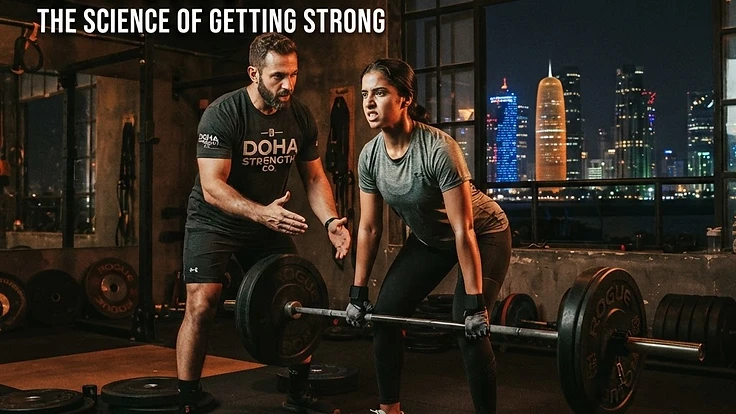
In Doha's crowded personal training landscape, certificates are easy to come by; genuine biomechanical literacy is not. A true strength coach does not hand you a pink dumbbell to perform squats while balancing on a Swiss ball. They act as movement analysts and technicians.
They evaluate bar path, hip drive, foot pressure, and spinal positioning down to the millimetre. They understand moment arms and classical mechanics, ensuring the bar moves in a vertical line over the midfoot to maximise efficiency and eliminate injury risk. If your trainer cannot explain the biomechanical difference between a low-bar and high-bar squat, or cannot show you how to properly set your thoracic spine during a deadlift lockout, they are a fitness companion, not a strength coach.
Where Serious Strength Happens in Doha
Doha's lifting scene has quietly matured over the last few years. While luxury hotel gyms often trade power cages for spa towels, several dedicated facilities have built environments where serious iron takes priority.
For those living near the northern corridor, View Gymmito Fitness Club (Lusail) on Fitseeka → offers the high-grade racks, platforms, and barbell stations necessary for structured compound lifting, combined with trainers who understand conditioning alongside pure barbell work. If you prefer a raw, community-rooted lifting culture closer to central Doha, View Dallah Gym (Al Markhiya) on Fitseeka → serves as a traditional bastion for heavy iron, functional training, and strength athletes who care about numbers on the bar rather than boutique aesthetics.
Women's Strength Training: Dispelling the Bulk Myth
The myth that lifting heavy weights makes women bulky has historically kept female trainees in Qatar confined to treadmills and light dumbbell step-ups. Thankfully, the culture across Al Rayyan and greater Doha is shifting. Bone mineral density, insulin sensitivity, joint stability, and metabolic rate are directly preserved through heavy resistance loading.
Women-only facilities are increasingly catering to this demand by bringing serious lifting gear into private, dedicated environments. Out in Al Rayyan, View Power House Gym (Muaither Ladies) on Fitseeka → gives lifters access to dedicated racks and platforms away from distractions, while View Rocka Power Gym Ladies on Fitseeka → provides specialised coaching setups for women wanting to learn proper barbell mechanics, powerlifting staples, and progressive conditioning.
Navigating the Qatar Climate and Lifestyle Factor
Applying structured strength science in Doha requires managing local environmental realities that directly affect your central nervous system:
- Hydration and Intracellular Electrolytes: Moving from air-conditioned offices in Msheireb or Education City to the brutal heat outside creates silent chronic dehydration. Heavy compound lifting demands high neural output; if your sodium and water levels are low, your nervous system cannot recruit high-threshold motor units. Salt your food and hydrate deliberately before training.
- Managing Late-Night Culture: Doha runs late. Whether it is dining out along the Corniche or family commitments running well past midnight, inadequate sleep stalls linear progression faster than bad programming. Deep sleep is when muscle protein synthesis occurs and your hormonal profile recovers. You cannot squat heavy three days a week on five hours of fragmented sleep.
- Fueling the Engine: Progressive overload demands a caloric and macronutrient surplus, specifically sufficient protein. Relying on nutrient-void delivery meals will leave your joints aching and your deadlift plateaued.
The Bottom Line
Sweating until you collapse is easy; building a 180kg deadlift or pressing your bodyweight overhead requires discipline, patience, and mechanics. If you want results that show up on the platform and carry over into everyday vitality, step away from the gimmicks. Find a coach who knows their mechanics, pick a proven program, and respect the barbell.