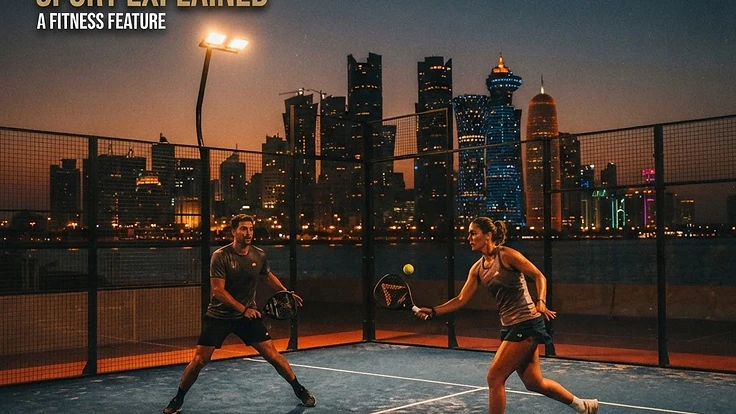
The 9:00 PM Phenomenon
Try booking a padel court anywhere in Doha on a Tuesday evening at short notice. You will find wall-to-wall red calendar slots across Playtomic and club booking apps. From 13-court indoor warehouses in Aspire Zone to scenic luxury waterfront setups at Marsa Malaz Kempinski on The Pearl, courts are packed until midnight with four-player crews hitting carbon-fibre racquets under bright LED banks.
Padel is not a passing trend in Qatar. It has fundamentally reshaped Doha's recreational culture. Qatar Sports Investments (QSI) acquired the World Padel Tour, the elite Premier Padel tour regularly stages its flagship Ooredoo Qatar Major at Khalifa International Tennis and Squash Complex, and local facilities have spread from Lusail down to Al Wakrah. To understand Doha's modern social life, you need to understand padel.
How Padel Took Over Qatar
Padel was invented in Acapulco in 1969 and took deep roots across Spain and Argentina before exploding internationally. Qatar's relationship with the sport gained serious momentum around 2017, when local sporting figures—most notably former national tennis team player and media personality Mohammed Saadon Al Kuwari—introduced dedicated courts at Qatar Sports Club.
The business model shifted decisively indoors with ventures like PADEL IN, recognizing that Doha summers require climate-controlled athletics. By eliminating heat and wind, indoor padel clubs turned what could have been a seasonal pastime into a 365-day habit. What began as a game played by transitioning tennis players quickly evolved into an everyday fitness staple for tens of thousands of citizens and expats across the country.
The Anatomy of the Addiction
Why did padel catch on faster in Qatar than squash, tennis, or standard five-a-side football? The sport eliminates the traditional barriers that make racquet sports intimidating for beginners:
- A forgiving learning curve: Tennis requires months of coaching simply to sustain an eight-shot rally. In padel, beginners can sustain dynamic, competitive rallies within 15 minutes of picking up a racquet.
- The glass equalizer: The 10-by-20-metre court is enclosed by toughened glass and mesh. When a shot slips past you, the back wall gives you a second chance off the rebound. Power matters far less than angles, placement, and anticipation.
- Built-in social chemistry: Padel is played almost exclusively in doubles. The compact court forces constant verbal communication, bantering, and quick coordination. Post-match specialty coffees at spots like Msheireb Downtown or Lusail Marina have become as integral to the ritual as the match itself.
- Accessible competition: Age gaps vanish on the padel court. Teenagers, busy corporate executives, and players in their fifties compete in the same mixed leagues without physical mismatch breaking the game.
Where Doha Plays
The city's court infrastructure is split across high-end hospitality venues and cavernous, purpose-built sports hubs.
For serious high-volume play, Aspire Zone anchors the scene with the massive PADEL IN indoor complex—one of the largest indoor padel facilities in the region. Further north, courts dot the Lusail shoreline and commercial hubs. In Central Doha, private and community clubs operate around Al Sadd, City Center Doha, and Msheireb.
Those looking for scenic outdoor sets during cooler winter months gravitate toward waterfront venues such as The St. Regis Doha in West Bay or the Doha Beach Club. But when the Gulf summer peaks from May through September, indoor courts with high industrial ceilings become Doha's hottest real estate.
The Physical Demands: It Is More Than Just a Social Hit
Do not mistake accessibility for lack of physical exertion. An intense 90-minute padel match is relentless interval training. You operate in a perpetual crouch, absorbing low balls off the glass, lunging sideways, and reacting with sudden rotational swings.
The physical toll shows up fast if you are unprepared. Without foundational strength, padel players regularly run into patellar tendinopathy from abrupt hard-court deceleration, lower-back tightness from twisted wall retrievals, and lateral epicondylitis (tennis elbow) from mis-timed wrist strikes.
To play three nights a week without picking up chronic injuries, you need supplementary strength and mobility work. Pairing court time with athletic conditioning at View Gymmito Fitness Club (Lusail) on Fitseeka → gives you the leg drive and core stiffness required for deep wall scrapes.
If you play your padel out around Aspire or Al Rayyan, targeted functional training at View F45 Training Sports City on Fitseeka → builds the anaerobic capacity and fast-twitch deceleration needed to track fast lobs. Meanwhile, island residents playing around Porto Arabia or Qanat Quartier can maintain shoulder stability and rotational endurance at View Gymmito Fitness Club (The Pearl) on Fitseeka →.
Active recovery also matters. Supplementing court sessions with structured laps or restorative mobility sessions at View M Active Club on Fitseeka → prevents hip and shoulder stiffness from setting in between weekly leagues.
How to Get Started Without Embarrassing Yourself
Getting onto the court in Doha requires zero background in competitive athletics, but a few ground rules make the transition painless:
- Download Playtomic: It is the de facto booking standard across Doha clubs. You can reserve courts, match with players at your rating, or jump into open community tournaments.
- Do not buy an elite carbon teardrop racquet on day one: High-end 'diamond' racquets have tiny sweet spots suited for power-hitting tournament players. Start with a round, low-balance control racquet with soft EVA foam. It protects your elbow and keeps balls on the court.
- Learn the walls early: Beginners run away from the glass. Advanced players let the ball hit the back wall and step in behind it. Spend your first two sessions practicing defensive rebounds off the back glass before trying to smash.
- Lock in your footwear: Do not play in soft running shoes. Padel involves sharp lateral cuts on sand-infilled artificial turf; running shoes will roll your ankle. Invest in padel-specific or herringbone-pattern tennis shoes with dedicated lateral grip.
The Bottom Line
Padel succeeded in Qatar because it solved Doha's hardest fitness problem: keeping people consistently moving, interacting, and competing inside a climate-controlled environment year-round. It is fast, relentlessly social, and easy to pick up—but deceptively demanding once you start playing for points. Book a court, dial in your footwear, and build the physical foundation to stay on it.